| . |  |
. |
| . | |
. |


Harnessing The Sun: NASA Studies Advanced Solar Cells On Station
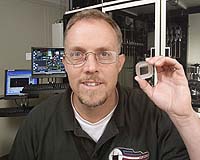
Cleveland OH (SPX) Nov 01, 2005 Did you know that instruments as small as postage stamps can keep a satellite operating in space for decades? It sounds unbelievable, but as they say, "from small beginnings great things come." And when engineers design space systems, they usually begin with small solar cells. These tiny semiconductors convert sunshine into electricity. Together, thousands of solar cells generate enough energy to power great things like the international space station, the Mars rovers and most of NASA's satellites. Over time, though, solar cells can degrade in the harsh environment of space. That's why the NASA Glenn Research Center, the Massachusetts Institute of Technology and Ohio State University have developed a new type of cell that is durable, lightweight and highly efficient. Most solar cells are made from silicon, an element used in computers, or gallium arsenide, a chemical compound often found in mobile phones. These materials have worked for years in space, but each has its own strengths and weaknesses. For instance, gallium arsenide solar cells produce twice as much power as silicon and are more durable, while silicon solar cells weigh less and conduct heat better. "Engineers have been trying to merge gallium arsenide solar cells with silicon for about 20 years," said Glenn Electrical Engineer David Wilt. "We believe we've overcome the problems they've had in the past." The Glenn team combined the best properties of each type of cell by depositing gallium arsenide layers on a silicon base. According to Wilt, the resulting hybrid cells can be manufactured to cover a much larger area than existing ones. That means solar arrays could be "highly efficient, about twice as light and much cheaper," Wilt said. The hybrid cells are part of the Forward Technology Solar Cell Experiment (FTSCE), which Astronaut Soichi Noguchi installed outside the international space station during STS-114. FTSCE is a part of the Materials International Space Station Experiment (MISSE), a collection of hundreds of material samples mounted on the outside of the space station. A collaborative effort between Glenn and the Naval Research Laboratory, FTSCE also contains advanced solar cells produced by the private industry. Researchers are studying how these new solar cells perform and endure in space. "Even though we have sunshine, rain and wind on Earth, space is a much more brutal environment," said FTSCE Systems Engineer Phillip Jenkins. "Among other things, materials in space have to withstand radiation and extreme temperatures." To monitor the experiment, Glenn engineers designed, built and programmed a data-acquisition system that takes measurements on command or automatically based on temperature, time and the position of the sun. A transmitter built by the U.S. Naval Academy then relays that data to researchers on Earth. "The experiment is facing the sun, so it's vulnerable to a lot of solar flares and radiation," said Electronics Engineer Michael Krasowski. "So far, we haven't seen a single hiccup in the data acquisition system." The 10-circuit-board data-acquisition system is much smaller and lighter than most electronics built to withstand space. The entire experiment, including the test cells and electronics, fits into a 2-foot by 2-foot by 4-inch container. FTSCE is scheduled to remain on the space station for one year. Just in case the test period is extended or the transmitter fails, Krasowski and the electronics team equipped the experiment with enough memory to collect data for more than two years. This isn't the first time FTSCE's electronics and photovoltaics teams have collaborated on ground-breaking experiments. The teams also built the Wheel Abrasion Experiment and the Materials Adherence Experiment, components of the 1996 Mars Pathfinder mission. These experiments measured the effects of dust on the Rover Sojourner's wheels and solar panel. When FTSCE returns, researchers will compare the data stored in its memory with the data transmitted from space. The new solar cells eventually could be used to power space systems traveling as far as Jupiter. Related Links SpaceDaily Search SpaceDaily Subscribe To SpaceDaily Express
 Agreement Establishes Energy-Efficient Home Collaboration
 Golden CO (SPX) Nov 01, 2005
A partnership between the U.S. Department of Energy's National Renewable Energy Laboratory (NREL) and the Sacramento Municipal Utility District (SMUD) will move forward energy-efficient home construction in California while advancing energy-efficient home research at NREL. |
|
|

| The content herein, unless otherwise known to be public domain, are Copyright 1995-2006 - SpaceDaily.AFP and UPI Wire Stories are copyright Agence France-Presse and United Press International. ESA PortalReports are copyright European Space Agency. All NASA sourced material is public domain. Additionalcopyrights may apply in whole or part to other bona fide parties. Advertising does not imply endorsement,agreement or approval of any opinions, statements or information provided by SpaceDaily on any Web page published or hosted by SpaceDaily. Privacy Statement |