| . |  |
. |
| . | |
. |


Germany's New Security Strategy
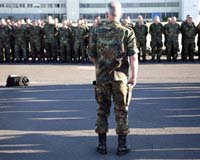
UPI Germany Correspondent Berlin (UPI) Oct 26, 2006 For the first time in 12 years, Germany has updated the strategy for its armed forces and security policy in a White Book that critics say lacks clear statements as to where Germany's security interests begin and end. "The White Book does not specify when Germany could and maybe should deny participation in an international mission," Wilfried Stolze, spokesman of the Bundeswehrverband, a soldier interest group, told United Press International. "Right now, there are no clear limits for participating in international missions." Drafted by the left-right grand coalition government of Chancellor Angela Merkel, the White Book identifies new challenges to German and global security, such as international terrorism, the proliferation of nuclear weapons, brewing regional conflicts and energy security. "Strategies that were previously effective in warding off external dangers are no longer adequate against the current asymmetric threats," the White Book says. "Effective security provisions require preventive, efficient, and coherent cooperation at both the national and international levels, to include an effective fight against the root causes." As Germany's security is "inseparably linked to the political development of Europe and the remainder of the world," the country would continue to work for global security in multilateral frameworks such as the European Union, NATO, the United Nations and the Organization for Security and Cooperation in Europe, the strategy paper says. The White Book specifically mentions the "overwhelming importance" of close relations with the United States, however, it said those ties had to be "continually cultivated and deepened through mutual consultation and coordinated action." The Bundeswehr, Germany's armed forces, has in the past 12 years developed into a force that is increasingly active in international missions. Berlin has some 2,750 soldiers in Afghanistan, and several thousand in other parts of the world, such as the Balkans, the Democratic Republic of Congo, and Lebanon. In the White Book Germany promises to provide up to 15,000 troops for NATO rapid deployment missions and 18,000 troops for the soon-to-be-launched European Union Battlegroups, deployable task forces (at 10 to 15 days' notice), each with a multinational strength of some 1,500 soldiers, designed "for rapid, robust action across the full range of tasks of the EU." By 2010, the Bundeswehr aims to have 327,000 total servicemen and women. The international community has praised the adoption of a new White Book as a necessary and long overdue step, especially given Germany's responsibilities in 2007, when Berlin will take over the rotating EU presidency and host the Group of Eight summit. Several past attempts to publish the White Book have failed, as former governments have disputed key elements of the paper. One was a statement on the future of the draft, which the Green Party, the coalition partner of the Social Democrats in the former government, had sought to abolish. This time, Merkel's conservatives and the Social Democrats expressed a clear commitment to the draft, but disagreed over another element that has been controversial since the terrorist attacks of Sept. 11, 2001 -- whether to deploy the Bundeswehr inside Germany in case of terrorist attack. Written in 1949, the German constitution established a strict separation between police and military, because the Nazis had blurred that separation, leading to political oppression by the military and a ruthless police state. Today, the police are responsible for the country's internal security -- including averting terror attacks -- and the army protects Germany outside its borders or in case of a military attack. The Social Democrats have opposed changing the constitution, while Interior Minister Wolfgang Schaeuble, a conservative, in recent months strongly lobbied to allow the Bundeswehr to be deployed domestically in case of terror attacks. The White Book tackles the issue by noting it was necessary to "expand the constitutional framework for the deployment of the armed forces." "Due to the new quality of international terrorism ... attacks are now also imaginable in Germany that, because of their type, objective and impacts exceed actual and legal parameters applied in classic hazard prevention." The line has surprised some experts, as it refuels a debate believed to be over. "It's interesting that Chancellor Merkel's conservatives have prevailed to include the phrasing that -- to enable deploying the Bundeswehr inside Germany -- one needed to alter the constitution," Benjamin Schreer, Bundeswehr expert at the German Institute for International and Security Affairs, told United Press International. "Otherwise, the phrasing remains rather vague, to allow for more leeway for future decisions." Such leeway bothers Stolze. "We need clear rules for our soldiers; we need to know what we may do and what not," he told UPI. "Especially when it comes to sea and aviation security in the case of terrorist attacks, the tasks for police and Bundeswehr must not overlap. We need more precise rules."
Source: United Press International Related Links The Military Industrial Complex at SpaceWar.com Learn about the Superpowers of the 21st Century at SpaceWar.com
 EU Leaders Back Plans For European Technology Institute
 Lahti (AFP) Finland, Oct 20, 2006
EU leaders meeting in Finland on Friday threw their weight behind plans to set up an elite research network, which aims to be Europe's answer to the prestigious Massachusetts Institute of Technology. "This is indeed a future flagship for innovation in Europe based on the important idea of public-private partnership, specifically the linkage between universities and business interests," European Commission chief Jose Manuel Barroso told reporters. |
|
|

| The content herein, unless otherwise known to be public domain, are Copyright 1995-2006 - SpaceDaily.AFP and UPI Wire Stories are copyright Agence France-Presse and United Press International. ESA PortalReports are copyright European Space Agency. All NASA sourced material is public domain. Additionalcopyrights may apply in whole or part to other bona fide parties. Advertising does not imply endorsement,agreement or approval of any opinions, statements or information provided by SpaceDaily on any Web page published or hosted by SpaceDaily. Privacy Statement |