| . |  |
. |
| . | |
. |


 by Brooks Hays London (UPI) Sep 12, 2016
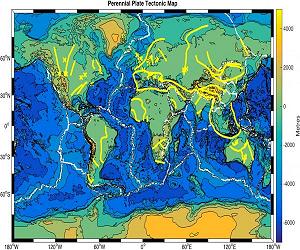
New research has revealed the movements of the ocean's tectonic plates during the Cretaceous normal superchron. Until now, the movements of oceanic plates during this period haven't been well understood. A superchron is a interval between two geomagnetic reversals -- a change in a planet's magnetic field -- lasting at least 10 million years. Earth's geomagnetic reversals, the back-and-forth of its polarity, provide geologists with big-picture benchmarks for studying the movement of tectonic plates. Minerals in newly solidified magma crystallize in alignment with the Earth's magnetic field, offering scientists historical evidence of Earth's polarity and the position of tectonic plates. But during superchrons, when the globe's geomagnetic field polarity remains stable, there are fewer obvious clues as to the movement of Earth's plates. To solve this problem, a team of scientists began the GEOPLATE project -- an effort to reveal more subtle geomagnetic anomalies on the ocean floor. Researchers used sensitive magnetic detection tools to document evidence of ancient fluctuations in the Earth's magnetic field. The survey revealed a variety of tiny geomagnetic "wiggles" during the Cretaceous normal superchron, or CNS, a period of normal polarity between 121 and 83 million years ago. Scientists believe their observations may help explain a variety of continental and oceanic phenomena dated to the time period, including the movement of surface tectonic plates, patterns of mantle convection and other geomagnetic field processes. Researchers say their new understanding of crustal production and sea floor spreading may help them explain the breakup of the ancient supercontinent Gondwana. Their observations may also explain how ancient tectonic shifts precipitated sea level rise. The new research could have implications for the present, as well. Tectonic movements yield a variety of global consequences. Changes on the ocean floor can alter the atmosphere. Researchers say the GEOPLATE project could help them better predict how changes on the ocean floor will impact climate change.
Related Links Tectonic Science and News
|
|||||||||||||
| The content herein, unless otherwise known to be public domain, are Copyright 1995-2026 - SpaceDaily. All websites are published in Australia and are solely subject to Australian law and governed by Fair Use principals for news reporting and research purposes. By using our websites you consent to cookie based advertising. If you do not agree with this then you must stop using the websites from May 25, 2018. Privacy Statement. Additional information can be found here at About Us. |


 del.icio.us
 Digg
Digg Reddit
 Google