| . |  |
. |
| . | |
. |


 by Staff Writers Zurich, Switzerland (SPX) Sep 07, 2016
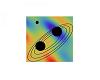
In his general theory of relativity, Albert Einstein predicted gravitational waves over a century ago; this year, they were detected directly for the first time: The American Gravitational Wave Observatory LIGO recorded such curvatures in space from Earth, which were caused by the merging of two massive black holes. And the research on gravitational waves - and thus the origin of the universe - continues: From 2034 three satellites are to be launched into space in a project headed by the European Space Agency (ESA) to measure gravitational waves at even lower frequency ranges from space using the Evolved Laser Interferometer Space Antenna (eLISA). Until now, however, it was not possible to conclusively predict the point at which gravitational waves are triggered and spread throughout space when galaxies merge. An international team of astrophysicists from the University of Zurich, the Institute of Space Technology Islamabad, the University of Heidelberg and the Chinese Academy of Sciences has now calculated this for the first time using an extensive simulation.
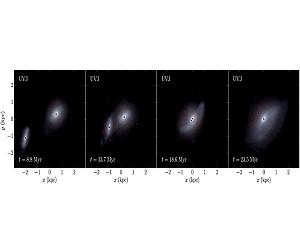
Much Faster Than Previously Assumed "The result is surprising," explains Lucio Mayer from the Institute for Computational Science of the University of Zurich: "The merging of the two black holes already triggered the first gravitational waves after 10 million years - around 100 times faster than previously assumed."
Year-Long Supercomputer Calculation Compared to previous models, the relation between the orbits of the central black holes and the realistic structure of the parent galaxies was factored into the present simulation. "Our calculations therefore allow a robust forecast for the merging rate of supermassive black holes in the early stage of the universe," explains Mayer. "They may help assess the gravitational waves eLISA is bound to find in the near future more effectively." Research paper: "Swift Coalescence of Supermassive Black Holes in Cosmological Mergers of Massive Galaxies," Fazeel Mahmood Khan, Davide Fiacconi, Lucio Mayer, Peter Berczik and Andreas Just, 2016 Sep. 10, Astrophysical Journal
Related Links University Of Zurich The Physics of Time and Space
|
|||||||||||||
| The content herein, unless otherwise known to be public domain, are Copyright 1995-2026 - SpaceDaily. All websites are published in Australia and are solely subject to Australian law and governed by Fair Use principals for news reporting and research purposes. By using our websites you consent to cookie based advertising. If you do not agree with this then you must stop using the websites from May 25, 2018. Privacy Statement. Additional information can be found here at About Us. |


 del.icio.us
 Digg
Digg Reddit
 Google