| . |  |
. |
| . | |
. |


Fire Scout Completes Complex Tracking Test
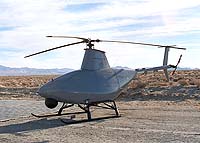
San Diego - Aug 22, 2002 Northrop Grumman Corporation's Integrated Systems sector has successfully conducted the first inflight sensor payload demonstration of the U.S. Navy's RQ-8A Fire Scout vertical takeoff and landing tactical unmanned air vehicle system at Naval Air Weapons Station, China Lake, Calif. The Fire Scout system is in development and low-rate initial production by Northrop Grumman as a force multiplier for Navy forces at sea and Marine Corps forces ashore. The Fire Scout payload, which is supplied by Northrop Grumman's Electronic Systems sector, Baltimore, Md., consists of electro-optical and infrared sensors and a laser designator/rangefinder, which provide intelligence, surveillance and reconnaissance imagery and data. As in previous Fire Scout flight tests, the preprogrammed autonomous mission included vertical takeoff, accurate navigation and return to a predetermined hover point in preparation for landing-all without operator intervention. In today's test, the Fire Scout flew for 30 minutes through 16 waypoints at the China Lake range. Using both the electro-optical and infrared sensors, Fire Scout located, identified and tracked a mix of targets including vehicles, buildings and geographic features. In addition, it employed the laser rangefinder to evaluate the precision target location feature of the payload and vehicle management system. During the flight, the vehicle climbed to a maximum altitude of 4,000 feet at an air speed of 100 knots. The ongoing flight series includes a number of important tests and has demonstrated the system's ability to take off, fly, navigate and land autonomously and collect imagery from its onboard sensor payload. Additional flight tests to support engineering and manufacturing development are planned this fall. Flight tests to demonstrate weapons targeting and delivery as well as shipboard landings are also being considered. The Fire Scout system is in development for the Navy and Marine Corps. Flying at altitudes up to 20,000 feet, it employs an advanced payload with an electro-optical/ infrared sensor including a laser designator/rangefinder to provide intelligence, reconnaissance and surveillance with pinpoint accuracy. This demonstrated system provides military decision-makers real-time information and targeting of enemy resources and personnel on the ground. The Fire Scout's communications suite allows simultaneous voice/data relay much farther than the "line of sight" limits of current systems. Fully autonomous, Fire Scout can fly high above deployed Marines to watch for threats within 150 nautical miles of the ground control station. The system then directs Navy and Marine weapons accurately to the target with precise target location coordinates or the laser designator. Fire Scout was designed to respond to Navy and Marine Corps emerging requirements and to replace the aging Pioneer. A complete system includes three UAVs, two ground control stations, a datalink suite and modular mission payloads. Related Links Northrop Grumman Integrated Systems SpaceDaily Search SpaceDaily Subscribe To SpaceDaily Express
 Spain Buys Fire Scout UAVs For F-100 Frigate Program
 Los Angeles - Aug 12, 2002
Northrop Grumman has signed a technical assistance agreement with IZAR of Spain, Europe's second largest shipbuilder, to promote the U.S. Navy's Fire Scout vertical unmanned system for integration on the country's F-100 frigate. |
|
|

| The content herein, unless otherwise known to be public domain, are Copyright 1995-2006 - SpaceDaily.AFP and UPI Wire Stories are copyright Agence France-Presse and United Press International. ESA PortalReports are copyright European Space Agency. All NASA sourced material is public domain. Additionalcopyrights may apply in whole or part to other bona fide parties. Advertising does not imply endorsement,agreement or approval of any opinions, statements or information provided by SpaceDaily on any Web page published or hosted by SpaceDaily. Privacy Statement |