


. 24/7 Space News .
Finding Tiny Particles In Hurricanes May Help With Predictions

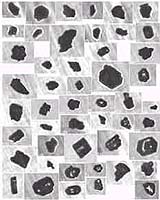
This is a picture of smaller ice crystal particles found at an altitude of 39,000 feet during a flight into Hurricane Humberto in 2001. These were imaged by the CPI (Cloud Particle Imager) is the high-resolution probe onboard NASA's ER-2 aircraft. The scale (200um) is in micrometers, equivalent to 0.2 millimeters. Larger particles are not depicted in this image. Researchers identified a large number of ice particles up to 7 millimeters in diameter in the upper reaches of the storm, accounting for why a hurricane is so reflective. Ice crystals reflect more sunlight and can lead to strong cooling near the tops of hurricanes, creating more of a temperature contrast between the warm storm and the cooler air surrounding it. Some of the larger particles have been transported to at least 35,000 feet, or may have grown there to large sizes through aggregation of smaller particles, a process that is usually thought to occur at warmer temperatures, usually around 18,000 feet.

Greenbelt - Apr 30, 2002
NASA-funded scientists are looking at microscopic ice particles inside hurricanes to determine if they contribute to the storm's strengthening or weakening. Researchers have discovered that greater numbers of ice particles higher up in a hurricane reflect more energy from the Sun out to space, creating a temperature difference that helps power the hurricane. The particles could also indicate a loss of energy into the surrounding atmosphere.

During a flight into Hurricane Humberto in 2001, researchers identified a large number of ice particles up to 7 millimeters in diameter in the upper reaches of the storm, around 39,000 feet high. The research was part of CAMEX-4 (The Convection And Moisture EXperiment), a joint effort between NASA, the National Oceanic and Atmospheric Administration (NOAA) and a number of universities.

"We've found that a high concentration of small particles at the top portion of a hurricane are very reflective, and they send more energy back to space than previously thought," said Andrew J. Heymsfield, researcher from the National Center for Atmospheric Research (NCAR), Boulder, Colo., and a lead author on a paper on the experiment.

Large concentrations of small ice crystals can reflect more sunlight and can lead to strong cooling near the tops of hurricanes, creating more of a temperature contrast between the bottom and top of the storm. That contrast of air temperatures could possibly contribute to its strength, just as a cold front moving into warm, moist air triggers thunderstorms.

"Updrafts of wind in hurricanes are generally pretty small, so some researchers did not expect large (up to 7 millimeters) particles, which generally form at warm temperatures, to exist at higher altitudes," Heymsfield said. Because large particles weigh more, they fall faster than small particles, and small particles can evaporate.


Related Links
SpaceDaily
Search SpaceDaily
Subscribe To SpaceDaily Express


Memory Foam Mattress Review
Newsletters :: SpaceDaily :: SpaceWar :: TerraDaily :: Energy Daily
XML Feeds :: Space News :: Earth News :: War News :: Solar Energy News


NASA, University Scientists See Prediction Of Solar Storms In Future
Huntsville - Apr 30, 2002
Much like tornado watchers look to the skies for clues that a twister is forming, NASA and university scientists are watching the Sun in an effort to better predict space weather -- blasts of particles from the Sun that impact the magnetosphere, the magnetic bubble around the Earth.


  • A Nickel's Worth Of Foil Helps Make Antimatter
  • NASA Ames Receives First Plant Images From Space Station
  • Italian Parachutist Plans To Jump Into Record Books
  • ESA Astronaut On Russian Flight To Space Station

  • Sending RATs to Mars
  • Global Surveyor Continues Its Watch on the Red Planet
  • Cosmonauts, Mind The Galactic Radiation
  • Fabrication of EuroMARS Begins!

  • Japan's H2A Has No Commercial Customers
  • Boeing Will Launch NASA Mission to Track Mother Nature
  • Squadron Destacks Titan II for other launch
  • ILS And Proton Successfully Launch Intelsat 903 Satellite

  • World First In Satellite-Based Monitoring Of Large Lake Areas
  • Civilian Satellites Used to Help Plan Attacks in Afghanistan
  • Orbimage Completes Voluntary Bankruptcy Filing
  • Boeing Joint Venture Wins NASA Contract

  • Hubble Hunts Down Odd Couples At The Fringes Of Our Solar System
  • Planetary Society to Congress: Restore Pluto and Europa Missions
  • Pluto Mission Planners Continue Development Of OuterPlanets Explorer
  • Exploring Pluto-Charon and the Kuiper Belt

  • NASA Ames Astrobiology Explorer Telescope Chosen For Feasibility Study
  • Astronomers Link X-Ray Flashes To Gamma-Ray Bursts
  • Energy Disappears High In Atmosphere, Scientists Say
  • Cosmic Vision 2020: The New ESA Science Programme

  • Moon and Earth Formed out of Identical Material
  • Lunar Soil Yields Evidence About Sun's Dynamic Workings
  • Unique tasks for SMART-1 in exploring the Moon
  • NASA Seeks Berth On India's Moon Mission

  • Orbital Wins $28 Million LA Transportation Management Contract
  • GPS Antenna Juggles More Birds Than Ever
  • AeroAstro Leverages Globalstar To Build Low-Cost Asset Tracker
  • TechnoCom To Equip 12,500 Vehicles With GPS Trackers And More

  • The content herein, unless otherwise known to be public domain, are Copyright 1995-2006 - SpaceDaily.AFP and UPI Wire Stories are copyright Agence France-Presse and United Press International. ESA PortalReports are copyright European Space Agency. All NASA sourced material is public domain. Additionalcopyrights may apply in whole or part to other bona fide parties. Advertising does not imply endorsement,agreement or approval of any opinions, statements or information provided by SpaceDaily on any Web page published or hosted by SpaceDaily. Privacy Statement