| . |  |
. |
| . | |
. |


Earth's Birth Date Turned Back: Formed Earlier Than Believed
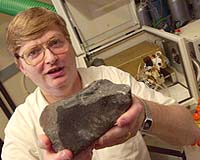
Boston - Jul 21, 2003 Our planet is 50 to 90 million years older than previously thought, according to new evidence found in meteorites. Mixtures of radioactive elements, which tick away like clocks, show that most of Earth had formed only 10 million years after the sun was born as a star, which took place about 4,567 million years ago. Previous measurements indicated an Earth birth of 60 million to 100 million years after the sun's nuclear fires began to burn. Mars, about half the size of Earth, may have formed 5 million years or less after our star's birth, or, like Earth, much faster than anyone believed. While Earth was still young, a stray boulder the size of Mars, or about 4,000 miles across, struck it and knocked off enough pieces to form the moon. "That occurred 30 million years after the sun formed, and it completed the building of Earth from gas and dust particles left over from the formation of the sun," says Stein Jacobsen, professor of geochemistry at Harvard University, who made the measurements. But Earth still was not covered by a hard crust. Jacobsen and Charles Harper, a former research associate in his laboratory, previously determined that this was not completed until 100 million years after the sun began to shine. The oldest rocks found on our planet date back to about 4,000 million (4 billion) years ago. Therefore, some 600 million years of history were lost in the melting and reworking of rocks as the young planet cooled down. There would be no way to make up for that loss without the radioactive clocks in meteorites that geologists are sure formed at the same times as Earth and the other planets. "One class of meteorites, known as chondrites, are the most primitive material in the solar system," Jacobsen points out. "They have never been melted like the rocks of the planets, so retain the earliest record of our solar system."
Rock clock ticks Jacobsen and his colleagues used a radioactive type of hafnium, a rare heavy metal, which decays into tungsten, a more familiar gray-white metal. The ratio of this type of tungsten to a stable variety of the same metal reveals how much hafnium decayed away, or how long the clock has ticked. "After 50 million years, the hafnium-tungsten timepiece is a dead clock because all the radioactive hafnium has decayed away," Jacobsen explains. "But for the first 50 million years of solar system history, it is ideal for tracking a planet's growth." Hafnium was not even known until the early 1920s. It was named after the Latin word for Copenhagen (Hafniae), where it was discovered. Measuring the ratio of hafnium-derived tungsten to stable tungsten requires special instruments, and is so difficult that no one succeeded until Jacobsen and Harper did it in an iron meteorite in the mid-1990s. Making the same measurement on chondrite meteorites, however, involves a higher level of difficulty. Scientists at the University of Michigan tried but did not find any differences in tungsten ratios between chondrites and the Earth, so they concluded that our planet must have formed between 60 to 100 million years after the sun. Jacobsen worked on improving the technique, and, with the help of research associate Qingzhu Yin, found that the amount of tungsten produced by radioactive hafnium in Earth's rocks is higher than that in the chondrites. These more accurate measurements showed that Earth built itself up from solar leftovers in only 10 million years, or quicker than anyone believed before. "Within 100,000 years of the formation of the sun, the first embryos of the planets Mercury, Venus, Earth, and Mars had formed," Jacobsen reported in the June 6 issue of Science. "Some grew more rapidly than others, and within 10 million years, about 65 percent of Earth had formed."
The Big Whack Pieces of Mars have been knocked off the Martian surface by meteorites from farther away, and were found in earthly places like Antarctica. From measurements made of these rocks and geological data sent back by unmanned spacecraft that landed on Mars, Jacobsen estimates that our neighbor could have been built in 5 million years or less. The hafnium clock was still ticking when a huge rock orbiting near Earth, perhaps a sister planet, took a gravitational turn for the worse. It slammed into Earth, scattering rocks beyond the pull of our gravity to attract them back. Their own gravities, however, pulled them together into a satellite 2,160 miles wide, circling 240,000 miles from us. Astronauts brought back hundreds of pounds of these rocks picked up during six moon landings. Examinations of the samples fit well with the so-called Big Whack theory of the moon's origin, and Jacobsen's work provides a lunar birth date of 4,537 million years. What on Earth happened after the hafnium clock stopped 4,517 million years ago? Before Jacobsen learned to read the clock so precisely, he and Harper used other kinds of radioactive rock clocks to determine when Earth became solid enough to stand on. They came up with a date of 4,467 years, or 100 million years after the interstellar gas and dust accreted into a fiery sun. Where did this gas and dust come from? Most astronomers believe it was debris from more primitive stars that blew up when they ran out of nuclear fuel. Such supernovas, as they are called, have been lighting up the universe for 10-12 billion years. Gravity gathers these construction materials into massive black clouds. Spectacular images of the insides of such clouds, taken by the Hubble Space Telescope, show young stars being born inside them. Billions of years from now the sun will finish burning its gas, and implode to pieces. The leftovers will join those from shorter-lived stars and solar systems. There will be radioactive hafnium in the mix and the clocks will start over again, timing the formation of new planets and moons, some of which may develop life intelligent enough to tell time by these exotic means. Related Links Harvard SpaceDaily Search SpaceDaily Subscribe To SpaceDaily Express
 An Evolutionary Fast-Track In Which The Hunted Outwit Their Hunters
 Ithaca - Jul 18, 2003
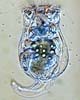
In the fishbowl of life, when hordes of well-fed predators drive their prey to the brink of extinction, sometimes evolution takes the fast track to help the hunted survive -- and then thrive to outnumber their predators. |
|
|

| The content herein, unless otherwise known to be public domain, are Copyright 1995-2006 - SpaceDaily.AFP and UPI Wire Stories are copyright Agence France-Presse and United Press International. ESA PortalReports are copyright European Space Agency. All NASA sourced material is public domain. Additionalcopyrights may apply in whole or part to other bona fide parties. Advertising does not imply endorsement,agreement or approval of any opinions, statements or information provided by SpaceDaily on any Web page published or hosted by SpaceDaily. Privacy Statement |