|
 |
 |
 |
 |
 |
 |
 |
 |
 |

| . |  |
. |
Earthlings' Low Signal-To-Noise?
Moffett Field CA (SPX) Dec 06, 2004 If ET ever phones home, chances are Earthlings wouldn't recognize the call as anything other than random noise or a star. New research shows that highly efficient electromagnetic transmissions from our neighbors in space would resemble the thermal radiation emitted by stars. University of Michigan physicist Mark Newman, along with biologist Michael Lachmann and computer scientist Cristopher Moore, have extended the pioneering 1940s research of Claude Shannon to electromagnetic transmissions in a paper published last month in the American Journal of Physics called, "The Physical Limits of Communication, or Why any sufficiently advanced technology is indistinguishable from noise." Lachmann is at the Max Planck Institute in Leipzig, Germany; Moore is at the University of New Mexico in Albuquerque. Their title echoes the well-known characterization by Sir Arthur C. Clarke that any sufficiently advanced technology is indistinguishable from magic. Shannon showed that a message transmitted with optimal efficiency is indistinguishable from random noise to a receiver unfamiliar with the language in the message. For example, an e-mail message whose first few letters are AAAAA contains little information because the reader can easily guess what probably comes next- another A. The message is totally non-random. On the other hand, a message beginning with a sequence of letters like RPLUOFQX contains a lot of information because you cannot easily guess the next letter. Paradoxically, however, the same message could just be a random jumble of letters containing no information at all; if you don't know the code used for the message you can't tell the difference between an information-rich message and a random jumble of letters. Newman and his collaborators have shown that a similar result holds true for radio waves. When electromagnetic waves are used as the transmission medium, the most information efficient format for a message is indistinguishable from ordinary thermal radiation - the same kind of radio waves that are emitted by hot bodies like stars. In other words, an efficiently coded radio message coming from outer space would look no different from a normal star in the sky. So, suppose an alien in space decided to pick up signs of Earth life. It would have a pretty easy time of it, since our radio and television signals are zigzagging all over the place and are inefficiently coded and easily distinguishable from stars. But say a human tries to tune into extraterrestrial life. "People do this, and when they do, they are looking for non-random stuff," Newman said. "But what if (the aliens) have gotten it down? With a few hundred years practice at doing this, you'd have discovered the most efficient way to encode your radio messages. So to us, their communication would look just like another star, a hot object." After all, Newman said, in the universe's 12 billion-year history, it's likely that extraterrestrials - if they exist - have communicated with each other longer than our paltry 80-year history of radio broadcasting. "In which case, they've probably gotten very good at this by now." Said Newman: "Our message is that, even for the people who do believe this, they're probably wasting their time. If they did pick up a signal from little green men, it would probably look like a star to them and they would just pass over it and move on to the next thing." Related Links SETI Institute SKA site Allen Telescope Array website SpaceDaily Search SpaceDaily Subscribe To SpaceDaily Express
 Young Stars Poised for Production of Rocky Planets
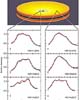 Garching, Germany (SPX) Nov 25, 2004
One of the currently hottest astrophysical topics - the hunt for Earth-like planets around other stars - has just received an important impetus from new spectral observations with the MIDI instrument at the ESO VLT Interferometer (VLTI). |
|
|

| The content herein, unless otherwise known to be public domain, are Copyright 1995-2006 - SpaceDaily.AFP and UPI Wire Stories are copyright Agence France-Presse and United Press International. ESA PortalReports are copyright European Space Agency. All NASA sourced material is public domain. Additionalcopyrights may apply in whole or part to other bona fide parties. Advertising does not imply endorsement,agreement or approval of any opinions, statements or information provided by SpaceDaily on any Web page published or hosted by SpaceDaily. Privacy Statement |