| . |  |
. |
| . | |
. |


Did Humans Cause Ecosystem Collapse In Ancient Australia?
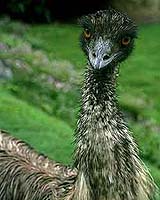
Washington DC (SPX) Jul 08, 2005 Massive extinctions of animals and the arrival of the first humans in ancient Australia may be linked, according to scientists at the Carnegie Institution, University of Colorado, Australian National University, and Bates College.* The extinctions occurred 45,000 to 55,000 years ago. The researchers traced evidence of diet and the environment contained in ancient eggshells and wombat teeth over the last 140,000 years to reconstruct what happened. The remains showed evidence of a rapid change of diet at the time of the extinctions. The researchers believe that massive fires set by the first humans may have altered the ecosystem of shrubs, trees, and grasses to the fire-adapted desert-scrub of today. The work is published in the July 8, issue of Science. The scientists plotted diet changes over 140,000 years of two species of large, flightless birds - the now-extinct Genyornis and the surviving emu (Dromaius) - in three Australian locations. They then corroborated their findings by analyzing ancient wombat teeth. "What your mother told you is true: You are what you eat," stated co-author of the study Marilyn Fogel of Carnegie. "Eggshells and teeth both contain evidence of these animals' diets in different forms of carbon. All three animals were plant eaters. Different types of plants metabolize different forms of carbon in distinctive ways from the CO2 they take up during photosynthesis. "The tell-tale carbon varieties were preserved in the eggshells and teeth and told us what types of plants the animals ate. We saw a sudden shift in plant type coincident with the arrival of humans. "The shifting diet shed light on the extinctions. The animals that relied mostly on the more palatable plant forms died out, such as Genyornis, while the animals that adapted to the less nutritious plants survived, including the emu." There are three isotopes, or varieties, of carbon found in nature - 12C, 13C and 14C. They differ in the number of neutrons in the nucleus. By far the most abundant variety is in the lightest, 12C. About 1% is 13C, a heavier sibling with an additional neutron. There is even less 14C, the unstable, radioactive heavyweight of them all. "13C is the key," Fogel explained. "There are two main ways plants metabolize 13C . About 85% of plants belong to what is known as C3 photosynthesis group. This group incorporates less 13C than plants belonging to the second most common class, C4. "Thus, the differences in 13C that we detected in the eggshells and teeth pointed to the type of plants that were consumed. Although, both types of plants were present before the extinctions, we saw a quick shift in dominance from C4 drought-resistant trees, shrubs and grasses, to C3 desert plants." Why did the scientists point to humans as the instigators of the ecological changes? First, they ruled out the other usual suspect - global climate change. They looked at their data in 15,000-year intervals back to 140,000 years ago. The period included dramatic climate changes, but no changes in the diet and environment until an abrupt transition was noted that corresponded to the arrival of humans. "Humans are the major suspect," commented Fogel. "However, we don't think that over-hunting or new diseases are to blame for the extinctions, because our research sees the ecological transition at the base of the food chain. "Bands of people set large-scale fires for a variety of reasons, including hunting, clearing, and signaling other bands. Based on the evidence, human-induced change in the vegetation is the best fit to explain what happened at that critical juncture." *The study was funded by the National Science Foundation. Co-authors include Gifford Miller of University of Colorado, John Magee and Mike Gagan of the Australian National University, Simon Clarke, a student at Carnegie's Geophysical Laboratory, and Beverly Johnson at Bates College. Related Links Australian National University Carnegie Institution Carnegie Institution of Washington SpaceDaily Search SpaceDaily Subscribe To SpaceDaily Express
 Ancient Diets Of Australian Birds Point To Big Ecosystem Changes
 Boulder CO (SPX) Jul 08, 2005
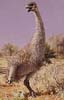
A shifting diet of two flightless birds inhabiting Australia tens of thousands of years ago is the best evidence yet that early humans may have altered the continent's interior with fire, changing it from a mosaic of trees, shrubs and grasses to the desert scrub evident today, according to a University of Colorado at Boulder-led team. |
|
|

| The content herein, unless otherwise known to be public domain, are Copyright 1995-2006 - SpaceDaily.AFP and UPI Wire Stories are copyright Agence France-Presse and United Press International. ESA PortalReports are copyright European Space Agency. All NASA sourced material is public domain. Additionalcopyrights may apply in whole or part to other bona fide parties. Advertising does not imply endorsement,agreement or approval of any opinions, statements or information provided by SpaceDaily on any Web page published or hosted by SpaceDaily. Privacy Statement |