| . |  |
. |
| . | |
. |


Detecting Chemical Threats With "Intelligent" Networks
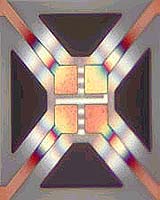
Washington - Sep 11, 2003 Prototype microsensor arrays connected to artificial neural networks�computer models that "learn"�can reliably identify trace amounts of toxic gases in seconds, well before concentration levels become lethal, National Institute of Standards and Technology (NIST) scientists and a guest researcher reported Sept. 7 at the American Chemical Society annual meeting in New York City. The system has the potential to provide cost-effective early warning of chemical warfare agents. Lab experiments show that the sensors, which use NIST-patented microheater technology, can detect compounds such as sulfur-mustard gas and nerve agents (tabun and sarin) at levels below 1 part per million. The neural networks, which currently run on a personal computer, were added recently to process signals from the sensor arrays. The networks enable the system to rapidly distinguish among the gases and predict their concentration in the ambient air. The microheaters, which are coated with metal oxide films, can be programmed to cycle through a range of temperatures. Airborne chemicals attach to the film in characteristic ways depending on factors such as temperature and film material, causing changes in the flow of electricity through the microsensors. These changes serve as a "signature" for identifying both the type and concentration of the gas in the ambient air. The neural networks were trained to detect subtle variations in these signatures. An array of four microheater sensors programmed to quickly sample 20 temperatures produces as much data as 80 different sensors. Research is ongoing to more fully assess the impact of background interference as a means of avoiding false positives, and to enhance the robustness of the sensors with repeated use. The research is funded by NIST and the Defense Threat Reduction Agency. Related Links Defense Threat Reduction Agency SpaceDaily Search SpaceDaily Subscribe To SpaceDaily Express
 Ensuring Quick Identification Of Radioactive Isotopes
 New York - Sep 11, 2003
One nightmare scenario: a terrorist dirty bomb is detonated in a major metropolitan area. Everyone's first question is "Who did it?". |
|
|

| The content herein, unless otherwise known to be public domain, are Copyright 1995-2006 - SpaceDaily.AFP and UPI Wire Stories are copyright Agence France-Presse and United Press International. ESA PortalReports are copyright European Space Agency. All NASA sourced material is public domain. Additionalcopyrights may apply in whole or part to other bona fide parties. Advertising does not imply endorsement,agreement or approval of any opinions, statements or information provided by SpaceDaily on any Web page published or hosted by SpaceDaily. Privacy Statement |