| . |  |
. |
| . | |
. |


 by Brooks Hays Washington (UPI) Jan 3, 2020
The first major meteor shower of 2020, the Quadrantids, will flash across dark, moonless skies during the predawn hours on Saturday morning. The Quadrantids arrive each year during the first week of January. They often put on a great show, featuring up to 100 meteors per hour during the shower's peak, but last year in North America, the timing wasn't quite right. "The reason the peak is so short is due to the shower's thin stream of particles and the fact that the Earth crosses the stream at a perpendicular angle," according to NASA. Last year, viewers in Asia and Europe saw plenty of action, but the curvature of the Earth blocked much of the view for sky-watchers in North America. This year's timing is much better. And a bonus, the skies will be moon-free. The Quadrantids are caused by the trail of debris left by 2003 EH1, an object astronomers think is a rock-comet -- almost an asteroid, not quite a comet. As Earth's orbit passes through the debris, the bits of rock and ice collide with the atmosphere and burn up, creating bright streaks in the night sky. The meteor showers are unique in that they are named for a constellation, "Quadrans Muralis," that isn't officially recognized. In 1795, the French astronomer Jerome Lalande named a group of stars for their likeness to a quadrant, the instrument used to pinpoint the location of stars. But in 1922, when the International Astronomical Union compiled an official list of constellations, they ignored Quadrans Muralis. "An alternative name for the Quadrantids is the Bootids since the meteors appear to radiate from the modern constellation of Bootes," according to NASA. "Even though, the constellation may no longer be recognized, it was considered a constellation long enough to give the meteor shower its name."
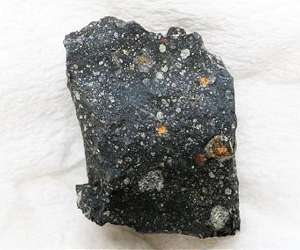
Sugar delivered to Earth from space Sendai, Japan (SPX) Nov 22, 2019 Researchers from Tohoku University, Hokkaido University, JAMSTEC, and NASA Goddard Space Flight Center investigated meteorites and found ribose and other sugars. These sugars possessed distinct carbon-isotope compositions, differing from terrestrial biological sugars, indicating their extraterrestrial origin. The results suggest that the sugars formed in the early solar system and made their way to earth via meteorites. The team analyzed three meteorites with their original protocol and found suga ... read more
|
|||||||||||||
| The content herein, unless otherwise known to be public domain, are Copyright 1995-2026 - SpaceDaily. All websites are published in Australia and are solely subject to Australian law and governed by Fair Use principals for news reporting and research purposes. By using our websites you consent to cookie based advertising. If you do not agree with this then you must stop using the websites from May 25, 2018. Privacy Statement. Additional information can be found here at About Us. |


 del.icio.us
 Digg
Digg Reddit
 Google







