|
 |
 |
 |
 |
 |
 |
 |
 |
 |

| . |  |
. |
Crescent Fluorescent Titan
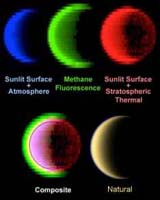
Moffett Field CA (SPX) Aug 06, 2004 The glow of Titan's extensive atmosphere shines in false colors in this view of Saturn's gas-enshrouded moon acquired by the Cassini spacecraft visual and infrared mapping spectrometer during the July 2, 2004, flyby. While flying over the terminator, where Titan's day and night meet, both the dayside and night sides are seen at various wavelengths. In these views of the crescent moon, the sunlit side is on the left and the nightside on the right. The blue image shows the sunlit crescent as observed at a wavelength that pierces through the thick atmosphere to show only the surface. This image is much smaller than the other three images to the right, because it does not show any atmospheric effects. In contrast, the green image shows the immense size of Titan's atmosphere. This is revealed by the fluorescent glow of methane gas, which extends over 700 kilometers (435 miles) above the surface, showing that the atmosphere nearly doubles the size of Titan. This glow is at a wavelength of 3.3 microns, five times the wavelength visible to the human eye. The red image shows that Titan also glows at night, which initially surprised scientists. The moon glows out to more than 200 kilometers (124 miles) in altitude, indicating carbon-monoxide emission at the 4.7 micron wavelength produced in Titan's relatively warm stratosphere. The multicolor images on the far right is a combination of the three upper images into one composite. Here it is seen that the carbon monoxide glow extends over the dayside as well, producing the yellow layer observed on the left. This is because the two glows, one from methane (green) and carbon monoxide (red) mix together to form yellow in this multi-color composite. Titan's surface is indicated by the circle. Titan's surface appears purple due to the mixing of the blue and red surface images. Related Links SpaceDaily Search SpaceDaily Subscribe To SpaceDaily Express
 Saturn's Shadow And Titan's Glow Shed Light On A Complex System
 Pasadena CA (JPL) Aug 06, 2004
The Cassini spacecraft, which began its tour of the Saturn system just over a month ago, has detected lightning and a new radiation belt at Saturn, and a glow around the planet's largest moon, Titan. |
|
|

| The content herein, unless otherwise known to be public domain, are Copyright 1995-2006 - SpaceDaily.AFP and UPI Wire Stories are copyright Agence France-Presse and United Press International. ESA PortalReports are copyright European Space Agency. All NASA sourced material is public domain. Additionalcopyrights may apply in whole or part to other bona fide parties. Advertising does not imply endorsement,agreement or approval of any opinions, statements or information provided by SpaceDaily on any Web page published or hosted by SpaceDaily. Privacy Statement |