| . |  |
. |
| . | |
. |


 by Staff Writers Melbourne, Australia (SPX) Nov 16, 2016
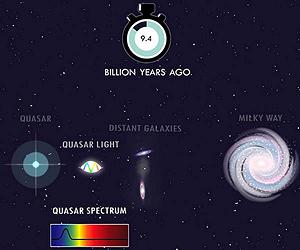
Researchers from Swinburne University of Technology and the University of Cambridge have confirmed that electromagnetism in a distant galaxy has the same strength as here on Earth. They observed a quasar - a supermassive black hole with enormously bright surroundings - located behind the galaxy. On its journey toward Earth, some of the quasar's light was absorbed by gas in the galaxy eight billion years ago, casting shadows at very specific colours. "The pattern of colours tells us how strong electromagnetism is in this galaxy, and because the quasar is one of the brightest ones known, we were able to make the most precise measurement so far," says lead author of the study, Swinburne PhD candidate Srdan Kotus. "We found electromagnetism in this galaxy was the same as here on Earth within just one part per million - about the width of a human hair compared to the size of a sports stadium."
Electromagnetism is one of the four known fundamental forces of Nature. Most previous attempts to measure electromagnetism have been limited by instruments called spectrographs - the 'light rulers' used to measure the pattern of shadows in the quasar's rainbow of colours. The researchers used spectrographs at the European Southern Observatory's Very Large Telescope (VLT) and 3.6-m Telescope in Chile to make their observations. "The VLT's spectrograph is a little inaccurate: it's a high-quality ruler for measuring light, but the numbers on that ruler are a little offset. So, to make the best measurement, we also used the 3.6-m Telescope's spectrograph to provide very accurate numbers," says Mr Kotus. "For me, finding that electromagnetism is constant over more than half the Universe's age just deepens the mystery - why is it that way? We still don't know," Professor Murphy says. "It's remarkable that distant galaxies provide such a precise probe of such a fundamental question. With even larger telescopes now being built, we'll be able to test it even better in the near future." The research has been published online in the Monthly Notices of the Royal Astronomical Society.

Related Links Swinburne University of Technology Stellar Chemistry, The Universe And All Within It
|
|||||||||||||
| The content herein, unless otherwise known to be public domain, are Copyright 1995-2026 - SpaceDaily. All websites are published in Australia and are solely subject to Australian law and governed by Fair Use principals for news reporting and research purposes. By using our websites you consent to cookie based advertising. If you do not agree with this then you must stop using the websites from May 25, 2018. Privacy Statement. Additional information can be found here at About Us. |

 del.icio.us
 Digg
Digg Reddit
 Google







