| . |  |
. |
| . | |
. |


 by Staff Writers Concordia, Antarctica (ESA) Apr 11, 2021
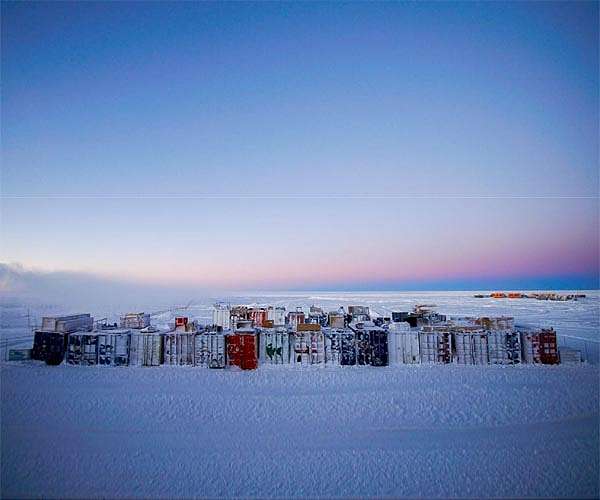
ESA-sponsored medical doctor Nick Smith snapped this photo of the storage containers at Concordia research station in Antarctica shortly before sunset, 8 April 2021. The dark blue line at the horizon is the shadow of the Earth. The containers store food, recycling and the scientific samples of blood, saliva, and stool that Nick routinely takes. The units on the right are part of the summer camp, during which researchers sleep in tents. Science for the benefit of space exploration does not only happen off planet. While some studies require the weightless isolation of the International Space Station, Antarctica also provides the right conditions for investigating the consequences of spaceflight, and it is a little easier to access than space. Part of the 17th crew to spend an entire year at one of the most remote bases in the world, Nick and 11 other crew members have taken up the adventurous challenge in the backdrop of a pandemic to continue important research that is furthering space exploration. Located at the mountain plateau called Dome C, Concordia is a collaboration between the French Polar Institute and the Italian Antarctic programme, and is one of only three bases that is inhabited all year long. As well as offering around nine months of complete isolation, Concordia's location at 3233 m altitude means the crew experience chronic hypobaric hypoxia - lack of oxygen in the brain. During the Antarctic winter, the crew of up to 15 people also endure four months of complete darkness: the sun disappears from May and is not seen again until late August. Temperatures can drop to -80C in the winter, with a yearly average of -50C. The temperature at the time of this image was -65C, with wind chill at about -80C. To put this cold into perspective, it was so cold that the camera battery died within ten minutes. As a station set in Earth's harshest space, Concordia is an ideal stand-in for studying the human psychological and physiological effects of extreme cold, isolation and darkness. For the rest of the year, Nick is poking and prodding the crew for samples to study changes in mood, immune systems, blood cells, and gut health.
Scientists measure ocean currents underneath 'Doomsday Glacier' Washington DC (UPI) Apr 9, 2021 For the first time, climate scientists have measured ocean conditions beneath Antarctica's Thwaites Glacier, sometimes called the "Doomsday Glacier." The fresh observations, published Friday in the journal Science Advances, show Thwaites is exposed to larger amounts of warm water than previously estimated. Thwaites is thought to be one of the West Antarctic Ice Sheet's most vulnerable glaciers, its location and structure making it especially susceptible to influxes of warm, salty water. ... read more
|
|||||||||||||
| The content herein, unless otherwise known to be public domain, are Copyright 1995-2026 - SpaceDaily. All websites are published in Australia and are solely subject to Australian law and governed by Fair Use principals for news reporting and research purposes. By using our websites you consent to cookie based advertising. If you do not agree with this then you must stop using the websites from May 25, 2018. Privacy Statement. Additional information can be found here at About Us. |

 del.icio.us
 Digg
Digg Reddit
 Google







