|
 |
 |
 |
 |
 |
 |
 |
 |
 |

| . |  |
. |
Coming Soon: "Good" Jupiters
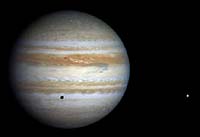
Moffett Field CA (SPX) Sep 30, 2004 We tend to think of Earth as the most important planet in our solar system. But if you were to eavesdrop on a group of astronomers from a distant world, discussing their initial investigation of our sun and its planets, Earth might not even be on the agenda. More likely, they'd be talking about Jupiter. Jupiter is huge. Its mass is 318 times that of the Earth. All of the planets in our solar system, even puny Pluto, do a gravitational dance with the sun, tugging the star this way and that as they sweep through their orbits. But Jupiter's effect is by far the greatest. It is this wobble, the sun's change in radial velocity caused by the tug of Jupiter's gravity, that would offer astronomers on faraway worlds the most obvious evidence that there are planets orbiting our sun. Indeed, it is the gravitational effect of giant planets on other stars that has enabled astronomers on Earth to find more than 130 extrasolar planets. Most of these planets are Jupiter-sized or larger. Planets that orbit close to their stars also have a detectability advantage. The closer in a planet is, the more quickly it completes a full orbit, so astronomers don't have to wait long to see a pattern emerge in its star's wobble. Some extrasolar planets complete their orbits in just a few days. These close-in giant planets have come to be known as "hot Jupiters." They comprise one of the two major groups of extrasolar planets discovered so far. Planets in the second group are known as "eccentric Jupiters." These massive worlds have elongated orbits that, like comets, dip in close to their stars and then swing out to great distances. "Between half and 1 percent of the stars are showing hot Jupiters. And then about another 7 percent are showing eccentric giant planets," says Greg Laughlin, a UC Santa Cruz astronomer who works with the UC Berkeley-based planet-hunting team headed by Geoff Marcy. The discovery of both hot Jupiters and eccentric Jupiters surprised astronomers. Work is ongoing to understand how solar systems so unlike our own could have formed. There is also debate about whether systems like those discovered so far can host habitable planets like Earth. What planet hunters would really like to find, though, is a third group of Jupiters, so-called "good Jupiters." Planets that orbit their stars in circular orbits at roughly the same distance that Jupiter orbits our sun, about 5 times the Earth-sun distance. The "good" thing about a solar system that contained a good Jupiter is that it might also harbor an Earth-like - and possibly life-bearing - planet. In our solar system, Jupiter plays two roles believed to be important to life on Earth. It helps to stabilize the orbits of the inner planets, which in turn helps to stabilize Earth's climate. And it keeps the inner solar system relatively free of comets and asteroids that could cause devastating impacts. Planetary systems that contain good Jupiters, therefore, will make excellent targets for future missions, such as Kepler, Darwin and the Terrestrial Planet Finder, that will be designed to hunt for Earth-sized planets. Why the delay in finding good Jupiters? Because planets so far from their stars take many years to complete an orbit. Jupiter, for example, takes nearly 12 Earth years to make a full trip around the sun. And astronomers need to observe a complete orbit to be confident that they have found a planet. "It's easy to get fooled if you don't see a full [orbital] period," Laughlin says. Planet hunting began in earnest only about 10 years ago. So it wasn't until 2002 that the first good Jupiter was found. The planet, slightly more massive than Jupiter, takes about 7 years to orbit its star, Gliese 777A. It is about 3.5 times as far from its star as Earth is from the sun. But astronomers are studying a number of other stars that also hold the promise of hosting good Jupiters. Over the next few years, we can expect to see the announcement of such planets to become commonplace. "Within 5 years," Laughlin says, "the announcement of a Jupiter-like planet on a truly Jovian orbit [won't even be reason to call] a press conference." Related Links 2MASS SpaceDaily Search SpaceDaily Subscribe To SpaceDaily Express
 Headshake To SETI Headfake
 Moffett Field CA (SPX) Sep 14, 2004
A recent (September 1) article in New Scientist magazine, entitled " Mysterious signals from 1000 light years away," implies that the UC Berkeley SETI@home project has uncovered a very convincing candidate signal that might be the first strong evidence for extraterrestrial intelligence. |
|
|

| The content herein, unless otherwise known to be public domain, are Copyright 1995-2006 - SpaceDaily.AFP and UPI Wire Stories are copyright Agence France-Presse and United Press International. ESA PortalReports are copyright European Space Agency. All NASA sourced material is public domain. Additionalcopyrights may apply in whole or part to other bona fide parties. Advertising does not imply endorsement,agreement or approval of any opinions, statements or information provided by SpaceDaily on any Web page published or hosted by SpaceDaily. Privacy Statement |