| . |  |
. |
| . | |
. |


China's Black-Necked Crane Under Satellite Surveillance
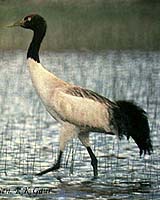
Kunming, China (XNA) Feb 15, 2005 China has launched its first ever observation of black-necked cranes with satellite remote sensing technology in a bid to better protect the rare bird species. The surveillance will be carried out on 10 chosen black-necked cranes spending winter at the Dashanbao Black-Necked Crane National Nature Reserve in southwest China's Yunnan Province over the next three years, according to the provincial forestry administration. The study is aimed to learn the migratory route of black-necked cranes and the places they stay, their retention cycle and their locations of reproduction, said Li Fengshan, a member of the International Crane Fund who takes charge of crane protection in China. The endangered black-necked crane is the only one of 15 crane species that inhabits in tablelands. Its tall and beautiful figure makes it valuable for bird-watching and scientific research. The black-necked cranes in China mainly live in Tibet and Yunnan and Guizhou provinces. Dashanbao Black-Necked Crane National Nature Reserve, in Zhaotong City of Yunnan, covers 192 square kilometers. Within its boundary, the altitude varies from 2,210 to 3,364 meters above sealevel. An estimated 1,100 black-necked cranes, or one sixth of its population in the world, spend about 200 winter days at the reserve each year. There are around 6,000 black-necked cranes in the world, 4,000 of which live in China. Source: Xinhua News Agency Related Links SpaceDaily Search SpaceDaily Subscribe To SpaceDaily Express
 New System Can Measure Productivity Of Oceans
 Corvallis OR (SPX) Feb 14, 2005
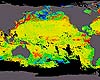
Researchers at Oregon State University, NASA and other institutions announced today the discovery of a method to determine from outer space the productivity of marine phytoplankton � a breakthrough that may provide a new understanding of life in the world's oceans. |
|
|

| The content herein, unless otherwise known to be public domain, are Copyright 1995-2006 - SpaceDaily.AFP and UPI Wire Stories are copyright Agence France-Presse and United Press International. ESA PortalReports are copyright European Space Agency. All NASA sourced material is public domain. Additionalcopyrights may apply in whole or part to other bona fide parties. Advertising does not imply endorsement,agreement or approval of any opinions, statements or information provided by SpaceDaily on any Web page published or hosted by SpaceDaily. Privacy Statement |