| . |  |
. |
| . | |
. |


China Build Up Could Mean Threat To US
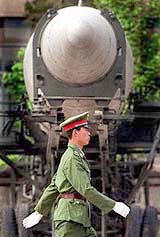
Washington (UPI) July 19, 2005 The Pentagon released Tuesday the long-awaited annual Chinese military power report, painting a picture of a nation bent on building up its military and learning the technological lessons of the U.S. wars in Afghanistan and Iraq. China's primary military focus remains Taiwan, specifically its interest in forcing the island nation to reunite with mainland China. "It's a very straightforward description of ... a significant military buildup that's been taking place," U.S. Defense Secretary Donald Rumsfeld said Monday. China has arrayed most of its most advanced weaponry and highly trained personnel across southeast China, postured to prevent Taiwan independence or "to compel Taiwan to negotiate a political settlement on Beijings terms," the report states. It includes an expanding force of ballistic missiles, both long and short range, cruise missiles, submarines, and advanced aircraft. While China's focus is now Taiwan, the Pentagon report notes that China's military could easily pose "a credible threat to other modern militaries operating in the region" if it continues its build up. "The pace and scope of China's military build-up are, already, such as to put regional military balances at risk. Current trends in China's military modernization could provide China with a force capable of prosecuting a range of military operations in Asia -- well beyond Taiwan." For now, however, the report says China has only limited abilities to project convention military power beyond its borders. The People's Liberation Army is buying new weapon systems and writing new doctrine, however, that could take it well beyond China's shores. "In the future, as China's military power grows, China's leaders may be tempted to resort to force or coercion more quickly to press diplomatic advantage, advance security interests, or resolve disputes," the report warns. Publicly, however, Beijing adopts a posture of non-confrontation, saying it wants to develop China's economic power and supports a policy of non-intervention in the internal affairs of other countries. China also has a "no-first-use" nuclear policy. Last week a Chinese general told reporters that if the United States drew its forces within striking distance of Chinese territory in an attempt to defend Taiwan, the country should use nuclear weapons against American forces. The officer, Maj. Gen. Zhu Chenghu, is an instructor at China's national defense university and said he was expressing his personal opinion only. China, however, is investing in its strategic nuclear missile force, both in numbers and capabilities. "It is fielding more survivable missiles capable of targeting India, Russia, virtually all of the United States, and the Asia-Pacific theater as far south as Australia and New Zealand." It has about 20 nuclear-tipped intercontinental ballistic missiles and about 20 medium-range missiles to counter regional threats. China is also investing in space forces. In 2004 alone it launched 10 satellites into orbit and hopes to have more than 100 satellites in orbit by 2010. At the same time it plans to field an anti-satellite laser. "The Defense Intelligence Agency believes Beijing eventually could develop a laser weapon capable of damaging or destroying satellites," the report states. The Pentagon for its part is focusing a large measure of its ongoing Quadrennial Defense Review deliberations on the threat posed by China and the possibility of having to fight a conventional or nuclear war against the country. The task of deciding what U.S. forces will be needed to counter or dissuade a Chinese threat is made more complicated by the fact that the U.S. government has no idea exactly how much China is investing in its military. In March, a Chinese government spokesman announced China would increase its "publicly disclosed-defense budget" in 2005 by 12.6 percent, to approximately $29.9 billion, double the amount it spent in 2000. "When adjusted for inflation, the nominal increases have produced double-digit actual increases in China's official defense budget every year since the mid-1990s. However, the officially published figures substantially underreport actual expenditures for national defense," the Pentagon report states. The report estimates that all told, China could be spending $90 billion in 2005 on military accounts, making it the third largest defense budget in the world. It is dwarfed by the U.S. defense budget at $420 billion. Speaking at the Pentagon Monday, Australian Prime Minister John Howard told reporters he doesn't believe China poses an aggressive military threat because of its keen interest in economic growth. "I think that China is a country that is growing in power and economic strength, but understands that military conflict of any kind is not conducive to her medium- and longer-term goals," Howard said. The Defense Intelligence Agency believes China's leaders recognize "that a war could severely retard economic development." Tawain is China's single largest source of foreign direct investment. The report also warns of "serious and numerous" consequences if the European Union lifts the arms embargo it has had in place against China since the 19898 Tiananmen Square crackdown. It would significantly improve China's access to military and dual use technologies; expertise in doctrine and training, and allow China to set up joint vetnrues with European companies to improve its space, radar, early-warning aircraft, submarine technology and electronics for precision guided munitions. It would also give China, as a major new customer for weaponry, economic leverage over Russia, Israel and other countries to expand the number of systems they will sell to Beijing. "Such an acceleration of China's military modernization would have direct implications for stability in the Taiwan Strait and the safety of U.S. personnel; it would also accelerate a shift ion the regional balance of power, affecting the security of many countries," the report states. Lifting the embargo would also give China more technology and advanced weaponry to transfer or sell to countries of concern, including Burma, Sudan and Zimbabwe. Related Links SpaceDaily Search SpaceDaily Subscribe To SpaceDaily Express
 Is Ningbo Bird's Goose Cooked?
 Beijing (UPI) July 19, 2005
Ningbo Bird, China's top domestic mobile handset seller, is one of several firms facing intensified competition as the stakes have been raised in the country's high-tech market. |
|
|

| The content herein, unless otherwise known to be public domain, are Copyright 1995-2006 - SpaceDaily.AFP and UPI Wire Stories are copyright Agence France-Presse and United Press International. ESA PortalReports are copyright European Space Agency. All NASA sourced material is public domain. Additionalcopyrights may apply in whole or part to other bona fide parties. Advertising does not imply endorsement,agreement or approval of any opinions, statements or information provided by SpaceDaily on any Web page published or hosted by SpaceDaily. Privacy Statement |