| . |  |
. |
| . | |
. |


Canadian experiment keeps astronauts safe
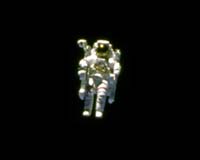
St. Hubert - Oct 22, 2001 The Canadian Space Agency (CSA) today announced Canada's latest space life science initiative, the Extra-Vehicular Activity Radiation Monitor (EVARM) experiment. Developed by Ottawa's Thomson Nielsen with funding from the CSA, EVARM will be used to measure the amount of radiation that astronauts receive while on a spacewalk, or extravehicular activity (EVA). "Radiation is an important variable in extra-vehicular activities," said CSA astronaut Chris Hadfield, the first Canadian to perform an EVA. "EVARM will provide information on radiation exposure that will help in the planning of future EVAs, enhancing the safety of astronauts working in space. I congratulate Thomson Nielsen on this innovative technology." In order to measure radiation levels during the spacewalk portion of a mission, small electronic badges will be placed inside astronaut EVA suits. The devices will record the amount of radiation reaching various locations on an astronaut's body while he or she works outside the shuttle or the International Space Station. "We are proud that our technology will be able to help resolve long unanswered questions regarding EVAs and space radiation," said Ian Thomson, the President of Thomson Nielsen and the Principal Investigator of EVARM. "Moreover, our work will not only help astronauts, but people on Earth as well. We have already used the technology behind EVARM in the development of a radiation monitor that can be used by medical practitioners for cancer patients." The EVARM equipment hardware will be carried to the International Space Station during NASA's next space misison STS-108, scheduled for launch on November 29, 2001. The actual experiments will be conducted during subsequent missions.
EVA And Radiation Management While on a spacewalk outside the space shuttle or the International Space Station (ISS), astronauts have only their EVA suit to protect them from the hazards of space. Not only does the suit provide them with air and a pressurized environment, it is their only source of protection from the dangerous radiation that streams from the sun or from farther regions of space. On Earth, our atmosphere shields us from most of that radiation. Astronauts on EVA, however, do not have the atmosphere to protect them so they are exposed to significantly higher levels of radiation than the average person on the ground. Measurements of radiation doses received only during the EVA have never been taken, so EVARM will be the first experiment to collect this type of data. Small electronic devices developed by Ontario's Thomson Nielsen will be placed in EVA suits to record the radiation astronauts encounter on their spacewalks. These badges, about the size of matchboxes, will be worn in three different locations inside the astronauts' suits, enabling researchers to determine the amount of radiation reaching different parts of the astronauts' bodies. The data obtained by these badges will also be examined in relation to the astronaut's location with respect to the Station at the time of the readings. The results obtained from EVARM will help researchers to better understand how to protect our astronauts while they work in earth orbit. EVARM will allow a much more precise estimation of an astronaut's radiation exposure during EVA, and it will provide the data necessary to more accurately predict radiation exposure on future flights. These factors will be key to keeping astronauts safe on future missions. EVARM also has important applications on earth. The technology behind the project has already been used by Thomson Nielsen in the development of a monitor for medical practitioners involved in cancer radiation treatments. Health care professionals such as doctors, radiation therapists and technicians are able to benefit from real-time skin-specific radiation monitoring of cancer patients based on the technology used in EVARM. The EVARM equipment hardware will be carried to the ISS on STS-108, scheduled for launch November 29, 2001. The actual experiments will be conducted during subsequent missions. Related Links Canadian Space Agency SpaceDaily Search SpaceDaily Subscribe To SpaceDaily Express
 Franco-Russian team on schedule for orbit rendezvous
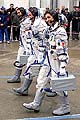 Baikonur (AFP) Oct 21, 2001
A rocket carrying a team of two Russian cosmonauts and a French woman cosmonaut lifted off from Kazakhstan on Sunday headed for the International Space Station. |
|
|

| The content herein, unless otherwise known to be public domain, are Copyright 1995-2006 - SpaceDaily.AFP and UPI Wire Stories are copyright Agence France-Presse and United Press International. ESA PortalReports are copyright European Space Agency. All NASA sourced material is public domain. Additionalcopyrights may apply in whole or part to other bona fide parties. Advertising does not imply endorsement,agreement or approval of any opinions, statements or information provided by SpaceDaily on any Web page published or hosted by SpaceDaily. Privacy Statement |