| . |  |
. |
| . | |
. |


 by Staff Writers Washington DC (SPX) Sep 07, 2016
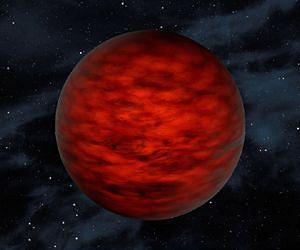
Cool brown dwarfs are a hot topic in astronomy right now. Smaller than stars and bigger than giant planets, they hold promise for helping us understand both stellar evolution and planet formation. New work from a team including Carnegie's Jonathan Gagne has discovered several ultracool brown dwarfs in our own solar neighborhood. Their findings are published in The Astrophysical Journal. Brown dwarfs are sometimes called failed stars. They are too small to sustain the hydrogen fusion process that powers stars, so after forming they slowly cool, contract, and dim over time. Their temperatures can range from nearly as hot as a star to as cool as a planet and their masses also range between star-like and giant-planet-like. They're fascinating to astronomers for a variety of reasons, mostly because they can serve as a bridge between stars and planets and how the former influences the latter, particular when it comes to composition and atmospheric properties. But much about them remains unknown. "Everyone will benefit from the study of brown dwarfs, because they can often be found in isolation, which means that we can more easily gather precise data on their properties without a bright star blinding our instruments," Gagne said, who is also a collaborator of the Institute for Research on Exoplanets (iREx) at Universite de Montreal. Discovering new brown dwarfs will help scientists to better quantify the frequency at which they occur both in our solar neighborhood and beyond. Knowing the abundance and distribution of brown dwarfs provides key information on the distribution of mass in the universe, and on the mechanism of brown dwarf formation, for example, whether they form in isolation or instead are ejected from larger planetary systems. To that end, the team, led by Jasmin Robert of Universite de Montreal, believed that although hundreds of ultracool brown dwarfs have already been discovered, the techniques used to identify them were overlooking those with more-unusual compositions, which would not show up in the color-based surveys generally used. So they surveyed 28 percent of the sky and discovered 165 ultracool brown dwarfs, about a third of which have unusual compositions or other peculiarities. When talking about brown dwarfs, ultracool means temperatures under about 3,500 Fahrenheit or 2,200 kelvin. "The search for ultracool brown dwarfs in the neighborhood of our own solar system is far from over," said Gagne. "Our findings indicate that many more are hiding in existing surveys." "A Brown Dwarf Census from the SIMP Survey," Jasmin Robert et al., 2016, to appear in the Astrophysical Journal
Related Links Carnegie Institution For Science Stellar Chemistry, The Universe And All Within It
|
|||||||||||||
| The content herein, unless otherwise known to be public domain, are Copyright 1995-2026 - SpaceDaily. All websites are published in Australia and are solely subject to Australian law and governed by Fair Use principals for news reporting and research purposes. By using our websites you consent to cookie based advertising. If you do not agree with this then you must stop using the websites from May 25, 2018. Privacy Statement. Additional information can be found here at About Us. |


 del.icio.us
 Digg
Digg Reddit
 Google