. 24/7 Space News .
Bright Comet Graces Northern Skys

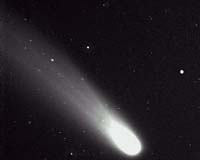
An image of Comet Ikeya-Zhang on the evening of Thursday, March 22, 2002, taken by the MicroObservatory telescope in Cambridge. The MicroObservatory project, created by the Science Education group at the Harvard-Smithsonian Center for Astrophysics, allows students and teachers across the nation to use telescopes over the Internet to take pictures of objects in the night sky.

Boston - Mar 22, 2002
The brightest comet since 1997's Hale-Bopp is currently gracing the western skies of North America. Comet Ikeya-Zhang (pronounced "ee-KAY-uh JONG") was discovered on February 1st by two amateur astronomers in Japan and China, respectively.

Calculations of the comet's orbit by Brian Marsden of the Harvard-Smithsonian Center for Astrophysics show that it was last seen in 1661. This makes Ikeya-Zhang the first long-period comet (a comet with a period longer than 200 years) to be identified on its return to the inner solar system.

No telescope is necessary to look at this beautiful visitor as it swings around the Sun and heads back to deep space. The comet has brightened to naked-eye visibility, but is easiest to see through binoculars.


Related Links
MicroObservatory
More info at Sky & Telescope
SpaceDaily
Search SpaceDaily
Subscribe To SpaceDaily Express


Memory Foam Mattress Review
Newsletters :: SpaceDaily :: SpaceWar :: TerraDaily :: Energy Daily
XML Feeds :: Space News :: Earth News :: War News :: Solar Energy News


Comet "Ikeya-Zhang" Returns 341 Years Later
 Washington - Mar 6, 2002
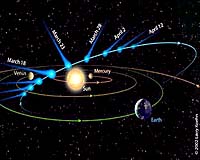
A comet discovered last month by amateur astronomers is making its first pass through the inner solar system in nearly 3-1/2 centuries. Named Ikeya-Zhang [pronounced "ee-KAY-uh JONG"] for the two keen-eyed skygazers who first spotted it, this cosmic interloper can be seen low in the west, not far above the horizon, as soon as it gets dark.


  • NASA's Fuse Satellite Lit Again
  • An Early NASA Pioneer Still On The Job In Deep Space
  • Pioneer 10 Returns Science From The Edge Of Sol
  • Distant Pioneer Sought One Last Time

  • Sorting Out Martian Ices
  • Mars Radiation Meter Back Online
  • University Of Dayton Geologist Recreates 'life On Mars' Evidence In Her Laboratory
  • Support For Critical Role Of Carbon Dioxide On Mars Grows

  • New Skies Bird Shipped To Kourou For April launch
  • Boeing Launches NASA Data Bird
  • Boeing Satellite for NASA Scheduled to Launch
  • Atlas 3 Launches EchoStar 7

  • Digital Photos From Solar Airplane To Improve Coffee Harvest
  • Jeppesen To Supply Worldwide Aviation Weather For Merlin Satellite Broadcast Service
  • Jason 1 Ready For Service, Releases First Data
  • Ariane 5 Ready To Launch Climate Monitoring Hub

  • Exploring Pluto-Charon and the Kuiper Belt
  • Pluto Flight Plan Trimmed To Save Time, Money and Fuel
  • Nuclear Hammers and Nuclear Hamstrings
  • A Plutonic Commitment To Space Funding

  • A Bow Shock Near A Young Star
  • NASA Says Its A New Dawn For Discovery
  • A Small Spherical Universe after All?
  • Ulysses Gets A New Partner In The Hunt For The Source Of Gamma-Ray Bursts

  • Moon and Earth Formed out of Identical Material
  • Lunar Soil Yields Evidence About Sun's Dynamic Workings
  • Unique tasks for SMART-1 in exploring the Moon
  • NASA Seeks Berth On India's Moon Mission

  • Europe Pushes Ahead With New GPS System Dubbed Galileo
  • GPS Helps Monitor Athletes at Utah Winter Olympics
  • Boeing Receives GPS IIF Modernization Approval
  • GPS, Other Military Systems Protected By FCC Decision

  • The content herein, unless otherwise known to be public domain, are Copyright 1995-2006 - SpaceDaily.AFP and UPI Wire Stories are copyright Agence France-Presse and United Press International. ESA PortalReports are copyright European Space Agency. All NASA sourced material is public domain. Additionalcopyrights may apply in whole or part to other bona fide parties. Advertising does not imply endorsement,agreement or approval of any opinions, statements or information provided by SpaceDaily on any Web page published or hosted by SpaceDaily. Privacy Statement