| . |  |
. |
| . | |
. |


Brain Power Packs In The Floating-Point Operations
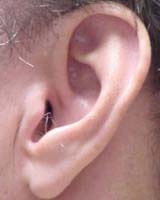
Washington DC (SPX) May 02, 2006 Read this aloud and your inner ear, by itself, will be carrying out at least the equivalent of a billion floating-point operations per second, about the workload of a typical game console. But what's truly amazing is the ear's efficiency. Consuming about 50 watts, that game console throws off enough heat to bake a cookie, whereas the inner ear uses just 14 millionths of a watt and could run for 15 years on one AA battery. If engineers could borrow nature's tricks, maybe they could build faster, better and smaller devices that don't literally burn holes in our pockets, writes Rahul Sarpeshkar in the May 2006 issue of IEEE Spectrum magazine. The idea, called neuromorphic engineering, has been around for 20 years, and the likely first application is bionics--the use of devices implanted into the nervous system to help the deaf, blind, paralyzed, and others. There are two reasons for this choice: the biological inspiration crosses over to the application, and the premium on energy efficiency is particularly important. Sarpeshkar's laboratory has constructed a bionic ear that consumes a mere twentieth of the power today's devices do. That makes the bionic ear small enough and energy-efficient enough to be fully implanted in a patient's head together with a two-gram battery needing a wireless recharge only every two weeks. As the best batteries currently available can be recharged about 1000 times, this device is the first to permit 30-year operation without surgery to replace the battery, according to Sarpeshkar, an associate professor of electrical engineering at Massachusetts Institute of Technology. This articles appears in full within the current issue of IEEE Spectrum Magazine Related Links IEEE Spectrum Magazine
 What Is The Sound Of One Person Talking
 Columbus OH (SPX) May 02, 2006
When researchers interviewed 40 Columbus residents about their opinions on life in the city, the scientists ignored what the people had to say. All the scientists really cared about was how they said it. |
|
|

| The content herein, unless otherwise known to be public domain, are Copyright 1995-2006 - SpaceDaily.AFP and UPI Wire Stories are copyright Agence France-Presse and United Press International. ESA PortalReports are copyright European Space Agency. All NASA sourced material is public domain. Additionalcopyrights may apply in whole or part to other bona fide parties. Advertising does not imply endorsement,agreement or approval of any opinions, statements or information provided by SpaceDaily on any Web page published or hosted by SpaceDaily. Privacy Statement |