|
 |
 |
 |
 |
 |
 |
 |
 |
 |

| . |  |
. |
Boeing Achieves First Submerged Unmanned Undersea Vehicle Recovery By A Submarine
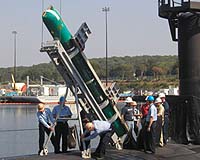
St. Louis MO (SPX) Nov 27, 2007 Boeing has successfully demonstrated for the first time that an unmanned undersea vehicle (UUV) can be recovered by an underway submerged submarine, opening up new possibilities for advanced naval operations. During recent tests, a U.S. Navy attack submarine launched the AN/BLQ-11 UUV from one of its torpedo tubes. The vehicle, formerly called the Long-term Mine Reconnaissance System (LMRS), then returned to the vessel, where the system's robotic arm retrieved it into the submarine. "With this recent success, Boeing has taken another important step in UUV development by demonstrating that the unmanned vehicle can return to the submarine and be recovered by a robotic arm," said Dan Jones, director of Boeing Advanced Information Systems, a division of Boeing Space and Intelligence Systems. "This milestone represents a critical next step for the U.S. Navy and opens the door for a whole new set of advanced submarine missions." The at-sea UUV tests follow earlier assessments during which Boeing and the Navy proved that the UUV could successfully home and dock with the system's robotic arm, while the submarine was underway. This milestone was achieved with a U.S. Navy attack submarine on its first attempt and repeated two days later on the second attempt. The AN/BLQ-11 system demonstrated all of the elements required for a complete UUV launch and recovery evolution. The U.S. Navy then secured from testing after having met all test objectives in half the allotted time. AN/BLQ-11 also performed several complex vehicle maneuvers during the tests, including station keeping and so-called "shadow submarine" during which the system operates underwater alongside the host submarine. Vehicle and system performance, deemed solid and predictable throughout the event, support the Navy's decision to pursue 21-inch diameter submarine-deployed UUVs. The U.S. Navy's Unmanned Undersea Vehicle program office selected Boeing in 1999 to work on the LMRS program, today called the AN/BLQ-11 system. The AN/BLQ-11 is designed to launch from the host submarine's torpedo tube to survey, detect and gather data on underwater threats such as mines that could pose significant risk to sailors. After completing its mission, the vehicle homes and docks with a robotic arm that extends from another of the host submarine's torpedo tubes for recovery back through the launch tube. The system allows operators to retrieve data from the vehicle and prepare it for re-launch. Community Email This Article Comment On This Article Related Links UAV News - Suppliers and Technology
 Elbit Systems To Supply UAV Systems To The Israeli Defense Forces
 Haifa, Israel (SPX) Nov 14, 2007
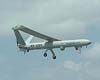
Elbit Systems received a new UAV order for the Israeli Defense Forces (IDF). The order, valued at approximately $30 million, includes the development, manufacture and supply of new and improved UAV systems, as well as the upgrade of existing UAV systems, designed to enhance and expand the IDF's existing UAV platform. Development and supply is scheduled to take place over a period that exceeds three years. |
|
|

| The content herein, unless otherwise known to be public domain, are Copyright 1995-2007 - SpaceDaily.AFP and UPI Wire Stories are copyright Agence France-Presse and United Press International. ESA Portal Reports are copyright European Space Agency. All NASA sourced material is public domain. Additional copyrights may apply in whole or part to other bona fide parties. Advertising does not imply endorsement,agreement or approval of any opinions, statements or information provided by SpaceDaily on any Web page published or hosted by SpaceDaily. Privacy Statement |