| . |  |
. |
| . | |
. |


Boeing-Built NASA Satellite Successfully Reaches Geosynchronous Orbit
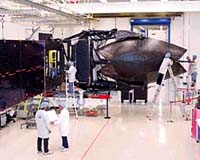
St. Louis - Oct 02, 2002 NASA's Boeing-built Tracking and Data Relay Satellite-I (TDRS-I) has reached GEO orbit where it will provide critical communications support for NASA's space shuttles, the International Space Station, and numerous scientific spacecraft. The achievement comes after a successful recovery effort made necessary when one of the spacecraft's two propellant fuel tanks did not properly pressurize shortly after its March 8 launch. In a procedure that could be compared to a "remote control coronary bypass" from 23,000 miles away, satellite controllers at Boeing Satellite Systems, in El Segundo, Calif., have rerouted fuel tank pressurant around a blocked valve and conducted a series of engine burns over the past four months to raise TDRS-I's orbit to 22,300 miles. The last burn was performed early Monday morning on Sept. 30. "The TDRS-I recovery effort was an incredible feat that demonstrates the inherent design robustness of our products and the incredible space operation knowledge and experience of our team," said Randy Brinkley, president of Boeing Satellite Systems. "I am so very proud of our TDRS-I team and the support and confidence our NASA customer has shown during this challenging period. All of us at BSS recognized how critical TDRS-I is to NASA's Space Shuttle and International Space Station and I am inspired by our joint team's efforts. "We could not have accomplished this recovery without a joint effort. NASA co-located their personnel in our Mission Control Center in El Segundo, and also provided support from their ground station network throughout the recovery effort. The joint effort showed what can be accomplished by working together." The satellite will now deploy its antennas and undergo at least eight weeks of in-orbit testing. Based on the remaining amount of propellant, the satellite is expected to fulfill its contractually required 15-year service life. TDRS-I is the second of three spacecraft BSS has delivered for NASA Goddard Space Flight Center of Greenbelt, Md. The first satellite, TDRS-H, was successfully launched in June 2000. The third satellite, TDRS-J, is scheduled for launch in November 2002. The TDRS fleet serves as the primary means of continuous, high-data-rate communication with the Space Shuttle, the International Space Station and dozens of unmanned scientific satellites in low earth orbit including the Hubble Space Telescope. The three new TDRS satellites will add Ka-band capability to the TDRS fleet, which will boost flexibility and allow transmissions at higher data rates.
Intergrated Motherhood: A unit of The Boeing Company, Boeing Integrated Defense Systems, or IDS, is one of the world's largest space and defense businesses. Headquartered in St. Louis, Boeing Integrated Defense Systems is a $23 billion business. It provides systems solutions to its global military, government and commercial customers. It is a leading provider of intelligence, surveillance and reconnaissance; the world's largest military aircraft manufacturer; the world's largest satellite manufacturer and a leading provider of space-based communications; the primary systems integrator for U.S. missile defense; NASA's largest contractor; and a global leader in launch services. Related Links Boeing Integrated Defense Systems SpaceDaily Search SpaceDaily Subscribe To SpaceDaily Express
 Aircraft Propulsion Experts Celebrate Ccentury Of Power for Flight
 Wright-Patterson - Sep 17, 2002
One hundred years ago, Orville and Wilbur Wright set out to solve the problem of flight. Their methodical experimentation with kites and gliders evolved into one of mankind's greatest inventions -- powered aircraft. |
|
|

| The content herein, unless otherwise known to be public domain, are Copyright 1995-2006 - SpaceDaily.AFP and UPI Wire Stories are copyright Agence France-Presse and United Press International. ESA PortalReports are copyright European Space Agency. All NASA sourced material is public domain. Additionalcopyrights may apply in whole or part to other bona fide parties. Advertising does not imply endorsement,agreement or approval of any opinions, statements or information provided by SpaceDaily on any Web page published or hosted by SpaceDaily. Privacy Statement |