| . |  |
. |
| . | |
. |


 by Brooks Hays Boulder, Colo. (UPI) Dec 30, 2015
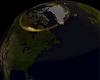
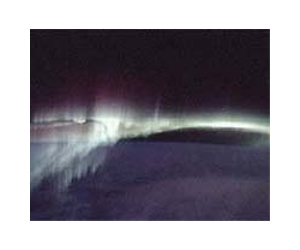
Earlier this week, NOAA's Space Weather Prediction Center reported an M1 solar flare and associated coronal mass ejection. The resulting geomagnetic storm hit Earth Wednesday morning. The center's forecast, published Tuesday, predicted a stronger G3 storm to last through Wednesday and a lesser G1 storm to persist through Thursday. The storming may result in the appearance of an aurora. If it lasts long enough and stays strong enough, that could mean a New Year's Eve light show for viewers at the right latitudes. "It's certainly possible," Terry Onsager, a NOAA physicist, told SFGATE. "It depends entirely on the strength of the storm. If it turns out to be stronger than that, it could be seen." Onsager says viewers in the Pacific Northwest may be in the best position to catch a glimpse of the New Year's Eve aurora. Auroras are created by the collision of high-energy solar particles with Earth's electromagnetic field. The electric disturbance excites gas ions in the upper atmosphere, causing them to glow various colors. The magnetosphere is thinnest at the poles, allowing the high-energy particles to penetrate into the upper atmosphere more easily. This is why auroras are seen most frequently at extreme latitudes -- aurora borealis, or Northern Lights, in the north, and aurora australis in the south.
Related Links Solar Science News at SpaceDaily
|
|||||||||||||
| The content herein, unless otherwise known to be public domain, are Copyright 1995-2026 - SpaceDaily. All websites are published in Australia and are solely subject to Australian law and governed by Fair Use principals for news reporting and research purposes. By using our websites you consent to cookie based advertising. If you do not agree with this then you must stop using the websites from May 25, 2018. Privacy Statement. Additional information can be found here at About Us. |


 del.icio.us
 Digg
Digg Reddit
 Google