| . |  |
. |
| . | |
. |


Atacama Rover Helps NASA Learn To Search For Life On Mars
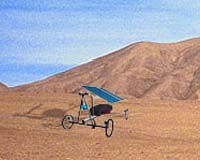
Moffett Field CA (SPX) Sep 27, 2004 A dedicated team of scientists is spending the next four weeks in northern Chile's Atacama Desert. They are studying the scarce life that exists there and, in the process, helping NASA learn more about how primitive life forms could exist on Mars. The NASA funded researchers are studying the Atacama Desert, described as the most arid region on Earth, to understand the desert as a habitat that represents one of the limits of life on Earth. The project, part of NASA's Astrobiology Science and Technology Program for Exploring Planets, involves technology experiments to test robotic capabilities for mobility, autonomy and science. "Identifying living microorganisms and/or fossils in environments where life's density is among the lowest on the planet should provide leads to establish detection criteria and strategies for Mars or other planetary bodies," explained Dr. Nathalie Cabrol of NASA's Ames Research Center (ARC), Moffett Field, Calif. She is the project science lead and co-investigator on the "Life in the Atacama" project. Scientists from ARC, Carnegie Mellon University, Pittsburgh, the University of Tennessee, Knoxville, Tenn., and the Universidad Catolica del Norte, Antofagasta, Chile, are participating in the study. Scientists are scheduled to conduct their investigation and field experiments in the Atacama through Oct. 21. They are using Zoe, an autonomous, solar-powered rover developed by researchers at Carnegie Mellon's Robotics Institute. During the mission, Zoe is expected to travel about two kilometers (1.24 miles) daily and provide panoramic and close-up images. Zoe will employ a variety of other scientific instruments to explore the remote desert. The instruments include a visible-to-near-infrared spectrometer and a fluorescence microscopic imager developed by Carnegie Mellon's Molecular Biosensor and Imaging Center. "Our goal is to make genuine discoveries about life and habitats in the Atacama and to create technologies and methods that can be applied to future NASA missions," said David Wettergreen, an associate research professor at Carnegie Mellon's Robotics Institute. He is leading robotics research for the Life in the Atacama project. The first phase of the project began in 2003, when a solar-powered robot named Hyperion, also developed at Carnegie Mellon, was taken to the Atacama. Scientists conducted experiments with Hyperion to determine the optimum design, software and instrumentation for a robot for extensive investigations during 2004-05 of desert life. Zoe and its instrument payload are the result of the first year's research. "The project is going a step further by trying to understand if signatures of microbial life can be unambiguously detected remotely using a robotic platform," Cabrol said. "These robots and science payloads will be a wonderful precursor to human exploration and excellent 'astronaut/astrobiology assistants' when the time comes for human missions," she added. Scientists also plan to map the habitats of the area, including its morphology, geology, mineralogy, texture, physical and elemental properties of rocks and soils; document how life modifies its environment; characterize the geo- and biosignatures of microbial organisms and draft science protocols to support a discovery of life. ARC scientist Chris McKay is conducting a long-term ecological study of the Atacama as a Mars analog environment. Scientists using EventScope, a remote experience browser developed by researchers at Carnegie Mellon's Studio for Creative Inquiry, will guide Zoe. EventScope enables scientists to experience the Atacama environment through the eyes and various sensors of the rover. Related Links EventScope SpaceDaily Search SpaceDaily Subscribe To SpaceDaily Express
 Cockroach-Like Robot Leads New Research Effort
 Berkeley CA (SPX) Sep 17, 2004
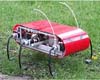
A cockroach-like robot named RHex is the starting point for a major project to understand animals' most distinguishing trait - how they move without falling over. |
|
|

| The content herein, unless otherwise known to be public domain, are Copyright 1995-2006 - SpaceDaily.AFP and UPI Wire Stories are copyright Agence France-Presse and United Press International. ESA PortalReports are copyright European Space Agency. All NASA sourced material is public domain. Additionalcopyrights may apply in whole or part to other bona fide parties. Advertising does not imply endorsement,agreement or approval of any opinions, statements or information provided by SpaceDaily on any Web page published or hosted by SpaceDaily. Privacy Statement |