| . |  |
. |
| . | |
. |


 by Brooks Hays Washington (UPI) May 23, 2018
Scientists have found six new dark galaxy candidates -- galaxies with few or no stars. As one can imagine, these starless, or near-starless, candidates aren't very bright, making them extremely hard to find. Astronomers are interested in understanding how galaxies form, as well as how stars emerge from the diffuse gas of the intergalactic medium. Dark galaxies promise insights into these mysteries. Unfortunately, dark galaxies are still only hypothetical. If confirmed, dark galaxies could offer astronomers a glimpse of galaxies before star formation begins in earnest. The theoretical galaxy consists of gas and dark matter, but has yet to develop the ability to form stars with any regularity. To study dark galaxies, scientists first have to find them, and a team of astrophysicists at ETH Zurich have developed a technique for doing so. To locate the six dark galaxy candidates detailed in their new paper -- published in the Astrophysical Journal -- the scientists used quasars as a flashlight. Quasars are extremely luminous supermassive black holes. Their accretion disks emit ultraviolet light. The high-energy rays trigger a fluorescent emission in hydrogen atoms called the Lyman-alpha line. The pulses from quasars make nearby dark galaxies briefly visible. Scientists have previously used a similar technique to look for dark galaxies, but researchers ETH Zurich targeted quasars farther away than has previously been possible. They also rendered the nearby dark galaxy candidates in a full spectral profile. "Our integral field survey provides a nearly uniform sensitivity coverage over a large volume in redshift space around the quasars as well as full spectral information at each location," researchers wrote in their paper. Their efforts revealed six strong dark galaxy candidates out of a total of 200 Lyman-alpha emitters.
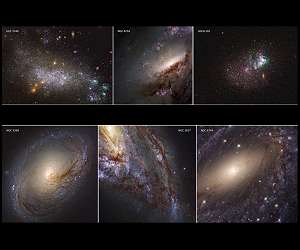
Astronomers Release Most Complete Ultraviolet-Light Survey of Nearby Galaxies Baltimore MD (SPX) May 18, 2018 Capitalizing on the unparalleled sharpness and spectral range of NASA's Hubble Space Telescope, an international team of astronomers is releasing the most comprehensive, high-resolution ultraviolet-light survey of nearby star-forming galaxies. The researchers combined new Hubble observations with archival Hubble images for 50 star-forming spiral and dwarf galaxies in the local universe, offering a large and extensive resource for understanding the complexities of star formation and galaxy evolutio ... read more
|
|||||||||||||
| The content herein, unless otherwise known to be public domain, are Copyright 1995-2026 - SpaceDaily. All websites are published in Australia and are solely subject to Australian law and governed by Fair Use principals for news reporting and research purposes. By using our websites you consent to cookie based advertising. If you do not agree with this then you must stop using the websites from May 25, 2018. Privacy Statement. Additional information can be found here at About Us. |

 del.icio.us
 Digg
Digg Reddit
 Google







