|
 |
 |
 |
 |
 |
 |
 |
 |
 |

| . |  |
. |
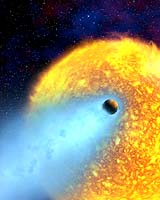
Astronomers Identify A Planet-Swallowing Giant Star
Sydney - Sep 24, 2003 Astronomers from Sydney University have come forth with a solution to a mysterious new object recently discovered in our Milky Way. In a letter soon to be published in the journal Monthly Notices of the Royal Astronomical Society, Dr Alon Retter and Dr Ariel Marom from the Department of Physics suggest that this phenomenon is an expanding giant star swallowing nearby planets, an event which may one day befall our own planet. Their research provides data to support the theory that the multi-stage eruption of the 'red giant' known as V838 Monocerotis observed last year was fuelled as it engulfed three near orbiting planets. This could be the first evidence for an event that had been predicted but not known to have been observed so far. The work identifies a new group of objects with stars that swallow planets. Astronomers had previously been unable to explain a spectacular explosion that transformed a dim innocuous star into the brightest cool supergiant in the Milky Way. The event was originally discovered by Australian amateur astronomer, Nicholas Brown in January 2002, when V838 Monocerotis suddenly became 600,000 times more luminous than our Sun. In an ordinary nova explosion, the outer layers of a compact star are ejected into space, exposing the super hot core where nuclear fusion was taking place. By contrast, V838 Monocerotis increased enormously in diameter and its outer layers cooled and were very disrupted but still conceal the giant's core. Beautiful images taken by the Hubble Space Telescope showed evidence of a previous eruption that ejected material from this object in the past. This too is very unusual. The Sydney team suggests that the outburst of V838 Monocerotis took place as it swallowed three massive Jupiter-like planets in succession. Evidence for this is provided through study of the shape of the light curve and comparison between the observed properties of the star and several theoretical works. In their scenario, in addition to the gravitational energy generated by the process, there may also have been a rapid release of nuclear energy as 'fresh' hydrogen was driven into the hydrogen burning shell of the post-main sequence star. Interestingly past studies have also suggested that the inner planets in our solar system, Mercury, Venus and maybe even Earth, should be eventually swallowed by the Sun. Previous research has proposed that this is in fact a common characteristic and that many giant stars have consumed planets during their evolution. The current work suggests that the engulfment of a massive planet can cause an eruption of the host star. Explaining the methods used during their study, Dr Retter said, "The careful inspection of the light curve of V838 Monocerotis showed that the three peaks have a similar structure, namely each maximum is followed by a decline and a very weak secondary peak. The shape of the light curve prompts us to argue that V838 Mon had three events of similar nature, but probably of different strengths. The obvious candidate for such behaviour is the swallowing of massive planets in close orbits around a parent star." According to this work, there should be more examples of expanding giants that swallow less and lighter planets thus showing weaker and less spectacular eruptions. Related Links Physics at Sydney SpaceDaily Search SpaceDaily Subscribe To SpaceDaily Express
 Built-In Eyeshade Offers Clue To Prehistoric Past
 Edmonton - Sep 19, 2003
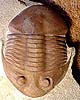
A new, rare fossil of a prehistoric sea creature bearing eyes like "twin towers" sheds light on how it lived more than 395 million years ago, says a University of Alberta researcher. Dr. Brian Chatterton, one of the world's leading experts on trilobites and a professor in the U of A's Faculty of Science, reports on the discovery of the only known complete specimen of a particular trilobite in this week's edition of the prestigious scientific journal Science. |
|
|

| The content herein, unless otherwise known to be public domain, are Copyright 1995-2006 - SpaceDaily.AFP and UPI Wire Stories are copyright Agence France-Presse and United Press International. ESA PortalReports are copyright European Space Agency. All NASA sourced material is public domain. Additionalcopyrights may apply in whole or part to other bona fide parties. Advertising does not imply endorsement,agreement or approval of any opinions, statements or information provided by SpaceDaily on any Web page published or hosted by SpaceDaily. Privacy Statement |