|
 |
 |
 |
 |
 |
 |
 |
 |
 |

| . |  |
. |
Asexual Cloning By Some Marine Invertebrate Larvae Not Overly Rare
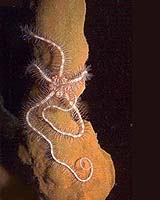
Edmonton - Sep 11, 2003 After more than a century of intensive study, scientists have assumed that larvae of non-parasitic invertebrates reproduce only very rarely, but new research by University of Alberta scientists overthrows this conventional wisdom. Graduate student Alexandra Eaves and Dr. Richard Palmer, from the U of A's Faculty of Science, have found that asexual cloning by some marine invertebrate larvae is not as rare and enigmatic a phenomenon as previously assumed. "A wealth of knowledge of how embryos grow has come from studying sea urchin development," said Eaves. "The discovery that these young animals can clone themselves provides an exceedingly rare opportunity to examine how a growing animal can repeat its own early development using a part of its body." Scattered earlier reports have observed that invertebrate larvae can spontaneously clone but Eaves and Palmer discovered this trait in three new echinoderm groups--sea cucumbers, sand dollars, and sea urchins--offering surprising new insight about chordate evolution. Larval cloning represents an intriguing new dimension to invertebrate life histories including the suggestion that clones may subsequently clone. The research is published in the current edition of the prestigious journal Nature. The larvae of echinoderms (the group that includes starfish, sea urchins, sea cucumbers, etc.) usually swim and feed for several months before transforming into a miniature adult. During this time some larvae form an outgrowth -- essentially a ball of tissue -- that pinches-off of the larval body and grows into a second, normal-looking larva--a clone. One of the most remarkable parts about the research is that for more than 100 years, scientists may have observed larval asexual reproduction, but did not recognize what they saw, said Palmer. Even more remarkably, at least one early report of larval cloning was dismissed as an artifact of laboratory culture conditions. "These data make it clear that people have likely seen this spontaneous cloning for many years but not recognized it," said Palmer. "This is a dramatic example of what terrifies scientists the most--when you see things with your own eyes but refuse to acknowledge it. It's a classic example of how deeply held beliefs may actually prevent you from seeing things." Related Links University of Alberta SpaceDaily Search SpaceDaily Subscribe To SpaceDaily Express
 Nurseries In The Deep Sea
 Moss Landing - Sep 09, 2003
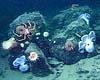
Exploring a deep-sea ridge off Northern California, scientists at the Monterey Bay Aquarium Research Institute (MBARI) have discovered a unique undersea nursery, where groups of fish and octopus brood their eggs, like chickens on their nests. This is the first time that marine biologists have directly observed any deep-sea fish brooding its eggs. |
|
|

| The content herein, unless otherwise known to be public domain, are Copyright 1995-2006 - SpaceDaily.AFP and UPI Wire Stories are copyright Agence France-Presse and United Press International. ESA PortalReports are copyright European Space Agency. All NASA sourced material is public domain. Additionalcopyrights may apply in whole or part to other bona fide parties. Advertising does not imply endorsement,agreement or approval of any opinions, statements or information provided by SpaceDaily on any Web page published or hosted by SpaceDaily. Privacy Statement |