| . |  |
. |
| . | |
. |


Ants Genetic Engineering Leads To Species Interdependency
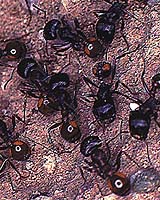
Tucson NM (SPX) Jan 11, 2005 Findings reported last week reveal how an evolutionary innovation involving the sharing of genes between two ant species has given rise to a deep-seated dependency between them for the survival of both species populations. The new work illustrates how genetic exchange through interbreeding between two species can give rise to a system of interdependence at a high level of biological organization - in this case, the production of worker ants for both species. Millions of years before the first modern humans evolved, ants were practicing many of the social innovations we consider to be our own: division of labor, agriculture, and even slavery. Indeed, these traits have been taken to their extreme in many ant species, such as the case of slavemaker ants, which have become so specialized for raiding food from the colonies of other ants that they can no longer feed themselves or raise their younger siblings. Recent work on ants suggests that we may need to add genetic engineering to the list of innovations ants have evolved to employ. In two species of harvester ants, populations have been discovered in which queens mate with males of another species to produce genetically novel hybrid workers. In a new study, Dr. Sara Helms Cahan and colleagues demonstrate that both of the species involved have effectively given up the ability to produce pure-species workers in favor of the hybrids, thereby becoming completely dependent on one another for survival. Female ants are generally found in two forms: reproductive queens and sterile workers. The role, or caste, of an individual is determined for life at a certain stage in her development. In virtually all ant species, it is the environment in which a female is raised, rather than a genetic predisposition, that determines which caste she will adopt. However, in two harvester ant populations in southern New Mexico, queens and workers from the same colonies are genetically very different; in both species at the site, only the queens are genetically derived from a pure species-specific lineage, whereas all the workers are hybrids that possess a combination of genes from the two species in a single individual. It is not currently known whether the ants benefit from having hybrids do the work, but, as is evident from the researchers' own attempts at selective breeding and genetic engineering, combining genomes is an easy way to produce novel characteristics that may be highly advantageous for growth, environmental tolerance, or disease resistance. Regardless of the specific advantages, however, it is clear that these ants have committed themselves to the hybrid workforce strategy. When the researchers prevented queens from mating with males of the other species, very few succeeded in making any workers at all, a handicap that would lead to certain population failure in the field. The new findings suggest that specialization involving reliance on interspecific hybrid workers has left these species unable to survive independently of one another. Sara Helms Cahan, Glennis E. Julian, Steven W. Rissing, Tanja Schwander, Joel D. Parker, and Laurent Keller: "Loss of Phenotypic Plasticity Generates Genotype-Caste Association in Harvester Ants" Published in Current Biology, Volume 14, Number 24, December 14, 2004, pages 2277�2282. Related Links SpaceDaily Search SpaceDaily Subscribe To SpaceDaily Express
 The Dynamo In The Cornfield
 Madison WI (SPX) Jan 07, 2005
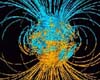
In an underground bunker that brushes up against a barnyard on one side and a cornfield on the other, scientists from the University of Wisconsin, Madison, are trying to solve an enduring cosmic mystery: how does the Earth generate its magnetic field - the vast, invisible web that shapes the aurora, makes compass needles point north, and shields us from solar storms? |
|
|

| The content herein, unless otherwise known to be public domain, are Copyright 1995-2006 - SpaceDaily.AFP and UPI Wire Stories are copyright Agence France-Presse and United Press International. ESA PortalReports are copyright European Space Agency. All NASA sourced material is public domain. Additionalcopyrights may apply in whole or part to other bona fide parties. Advertising does not imply endorsement,agreement or approval of any opinions, statements or information provided by SpaceDaily on any Web page published or hosted by SpaceDaily. Privacy Statement |