| . |  |
. |
| . | |
. |


Ant Invaders Eat The Natives, Then Move Down The Food Chain
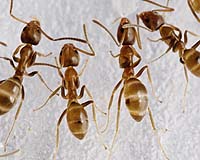
Champaign IL (SPX) Dec 19, 2007 The Argentine ant, Linepithema humile, is one of the most successful invasive species in the world, having colonized parts of five continents in addition to its native range in South America. A new study sheds light on the secrets of its success. The findings, from researchers at the University of Illinois and the University of California at San Diego, appear this week in the Proceedings of the National Academy of Sciences. The Argentine ant is tiny, aggressive and adaptable, traits that have helped it in its transit around the world. Once seen only in South America, the ant is now found in parts of Asia, Australia, Europe, North America and South Africa. It most likely made its way to these destinations on ships carrying soil or agricultural products. Under the right conditions, the Argentine ant marches through a new territory, wiping out - by eating and out-competing - most of the native ants and many other insects. In the process it radically alters the ecology of its new home. The Argentine ant thrives in a warm climate with abundant water, and is often found on agricultural lands or near cities. But it also invades natural areas, said U. of I. entomology professor Andrew Suarez, principal investigator on the new study. The ant is highly social, and sometimes forms immense "super-colonies" made up of millions workers spread over vast territories. In previous research, Suarez identified a super-colony in California that stretched from San Diego to San Francisco. In the new study, Suarez and colleagues followed an invasion wave of Argentine ants across Rice Canyon, in southern California. The researchers tracked the invasion for eight years, collecting data on conditions before and during the invasion. "Rather than comparing an invaded to a non-invaded community, which may be different for all sorts of other reasons, we try to follow an invasion front in real time to document what this invader is doing," Suarez said. The researchers used a technique called stable isotope analysis to determine what the ants were eating. By calculating the ratio of heavy to light isotopes (molecular weights) of nitrogen in all members of an ecological community, scientists can determine if a particular organism is primarily a carnivore or herbivore. What the researchers found surprised them. In the early stages of invasion the Argentine ants behaved much as they did in their own home ranges: They were carnivores, aggressively attacking and probably eating most of the other ants they encountered. But as they displaced the native species, they began foraging lower on the food chain. Field studies showed that the ants were taking over an important food source: the honeydew excretions of aphids and scale insects that feed on plants. "These are really important, often fixed resources, from which ants can get a huge amount of their carbohydrate fuel, the energy to fuel their worker force," Suarez said. "As the native ants are displaced, the Argentine ants start monopolizing these resources." The impact on the natives was disastrous. Over a period of eight years, the number of native ant species in the study area went from 23 to two. The findings point to a need for more long-term studies of native and non-native species, Suarez said, rather than the more common, short-term studies, which see only a fragment of the bigger puzzle. "The way the invasive species are interacting with the environment might actually be changing over time," Suarez said. Only by following an invasion over time can researchers begin to understand the dynamics that allow alien species to win out over the natives, he said. Community Email This Article Comment On This Article Related Links Darwin Today At TerraDaily.com
 Lost Worlds Of West Papua Reveal More Surprises
 Arlington VA (SPX) Dec 18, 2007
A tiny possum and a giant rat were recorded by scientists as probable new species on a recent expedition to Indonesia's remote and virtually unknown "Lost World" in the pristine wilderness of western New Guinea's Foja Mountains. Conservation International (CI) and Indonesia Institute of Science (LIPI) scientists were accompanied by the first film crew to obtain footage of the region and its wildlife on an expedition to the Fojas in June 2007. |
|
|

| The content herein, unless otherwise known to be public domain, are Copyright 1995-2007 - SpaceDaily.AFP and UPI Wire Stories are copyright Agence France-Presse and United Press International. ESA Portal Reports are copyright European Space Agency. All NASA sourced material is public domain. Additional copyrights may apply in whole or part to other bona fide parties. Advertising does not imply endorsement,agreement or approval of any opinions, statements or information provided by SpaceDaily on any Web page published or hosted by SpaceDaily. Privacy Statement |