| . |  |
. |
| . | |
. |


Another Twist In The Field Of Superconductivity
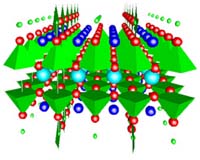
Montreal QC - Mar 24, 2004 Researchers at the U.S. Department of Energy's Brookhaven National Laboratory have discovered an interesting type of electronic behavior in a recently discovered class of superconductors known as cobalt oxides, or cobaltates. These materials operate quite differently from other oxide superconductors, namely the copper oxides (or cuprates), which are commonly referred to as high-temperature superconductors. When traditional superconductors are cooled to nearly absolute zero (0 Kelvin or �452 degrees Fahrenheit), pairs of negatively charged electrons exchange packets of vibrational energy known as phonons. This mechanism overcomes the repulsion of the like-charged particles and allows them to move together to carry electrical current with virtually no resistance. But the mechanism for superconductivity in the high-temperature cuprates -- which act as superconductors at temperatures as "warm" as 138 K -- is still one of the "hottest" mysteries in condensed matter physics. Above the superconducting transition temperature the cuprates do not exhibit normal electronlike behavior, so it's unclear either how or what is pairing to carry the current. With the discovery of a new class of oxide superconductors, the cobaltates (which become superconducting at a temperature around 5 K), scientists were naturally curious whether they could learn something about their mechanism to shed light upon this problem. "What we've found," says Brookhaven physicist Peter Johnson, "has opened up another twist." As Johnson's group cooled the cobalt-oxide materials, they observed electronlike excitations at temperatures well above the so-called transition temperature where the materials become superconductors. "If we had discovered these before we discovered the cuprates we'd probably think the same electron pairing mechanism was responsible for all superconductivity," Johnson says. Johnson will explore the implications of this work in his talk during the session on "Novel and Complex Oxides IV" on Tuesday, March 23, at 2:42 p.m. in room 511E. This research is funded by the Office of Basic Energy Sciences within the Department of Energy's Office of Science. Related Links Brookhaven National Laboratory SpaceDaily Search SpaceDaily Subscribe To SpaceDaily Express
 INEEL Designing Prototype System For Yucca Mountain Repository
 Idaho - Mar 16, 2004
The U.S. Department of Energy's Idaho National Engineering and Environmental Laboratory is designing a prototype remote-controlled system that will permanently close the waste packages of spent nuclear fuel before final disposal in the proposed federal repository being studied at Yucca Mountain in Nevada. |
|
|

| The content herein, unless otherwise known to be public domain, are Copyright 1995-2006 - SpaceDaily.AFP and UPI Wire Stories are copyright Agence France-Presse and United Press International. ESA PortalReports are copyright European Space Agency. All NASA sourced material is public domain. Additionalcopyrights may apply in whole or part to other bona fide parties. Advertising does not imply endorsement,agreement or approval of any opinions, statements or information provided by SpaceDaily on any Web page published or hosted by SpaceDaily. Privacy Statement |