| . |  |
. |
| . | |
. |


 by Staff Writers Rochester NY (SPX) Oct 21, 2022
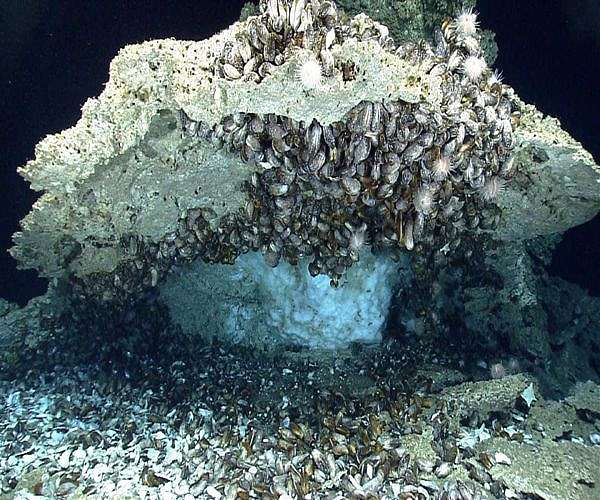
Deep below the ocean's surface, the seafloor contains large quantities of naturally occurring, ice-like deposits made up of water and concentrated methane gas. For decades, climate scientists have wondered if this methane hydrate reservoir might "melt" and release massive amounts of methane to the ocean and the atmosphere as ocean temperatures warm. New research from scientists at the University of Rochester, the US Geological Survey, and the University of California Irvine is the first to directly show that methane released from decomposing hydrates is not reaching the atmosphere. The researchers, including John Kessler, a professor in the Department of Earth and Environmental Sciences, and DongJoo Joung, a former research scientist in Kessler's lab and now an assistant professor in the Department of Oceanography at Pusan National University in Korea, carried out the study in mid-latitude regions-Earth's subtropical and temperate zones. While the stability of the methane hydrate reservoir is sensitive to changes in temperature, "in the mid-latitude regions where this study was conducted, we see no signatures of hydrate methane being emitted to the atmosphere," says Joung, the first author of the study, published in Nature Geoscience.
How methane hydrates form, stabilize, and degrade Ocean sediments are massive storehouses for ancient reservoirs of natural methane in the form of methane hydrates. "The amount of methane locked up in gas hydrates globally is staggering," Joung says. Scientists have hypothesized that the release of even part of this reservoir could significantly exacerbate climate change. Says Kessler: "Imagine a bubble in your fish tank going from the bottom of the tank to the top and exploding and releasing whatever was in that bubble to the air above it-that was the way many people viewed how hydrate decomposition might contribute to our warming world." Gas hydrates form where both methane and water meet at high-pressure and low-temperature conditions. In the parts of the ocean located in the temperate and subtropical mid-latitudes, hydrates can remain stable only at depths below about 500 meters (approximately 1640 feet) beneath the sea surface. Generally, hydrates become more stable the deeper they are beneath the sea surface. That means the upper stability boundary for methane hydrates-500 meters-is a "sweet spot." It is the most susceptible to melting under warming seawater temperatures, and it is the shortest distance a bubble of "previously-hydrated" methane would have to travel before reaching the atmosphere. But even in this sweet spot, the researchers did not observe evidence of hydrate methane being emitted to the atmosphere.
Fingerprinting the methane source To make even one measurement, they need an enormous amount of water-a single sample includes about two thousand gallons of seawater. The researchers used a giant suction hose to collect the samples and employed a novel technique their team developed that involves extracting methane from each sample. The researchers compressed the methane into cylinders that they then brought back to Kessler's lab on the River Campus to prepare for analysis. As the researchers documented, ancient methane is being released from the seafloor. However, they found negligible amounts of this ancient methane in the surface waters. They concluded, based on earlier studies, that this methane gas first dissolves in the deeper waters and then oceanic microbes biodegrade the methane, turning it into carbon dioxide before it leaves the water. Previous work by Kessler's group and others found that these processes are active in the mid-latitude regions and that similar processes helped to mitigate the effects of methane released during the Deepwater Horizon oil spill. Carbon dioxide, while also a greenhouse gas, "can be incorporated into other carbon reservoirs in seawater," says Kessler. While some of the carbon dioxide could also be emitted into the atmosphere, it would happen over much longer time scales-thousands of years-and the warming wouldn't be as acute. The new study builds on previous work in Kessler's lab, focused on methane hydrates in the Arctic Ocean. Arctic waters are another sweet spot for the study of hydrates because the cold temperature means that hydrates destabilize in shallower waters, where they have a short distance to travel to reach the atmosphere. Kessler calls these results "good news"-but news that underscores the work that remains. "This tells us that in order to reduce sources of methane to the atmosphere, we can focus more of our attention on mitigating human emissions," he says.
Research Report:Negligible atmospheric release of methane from decomposing hydrates in mid-latitude oceans

UK slams HSBC over 'misleading' climate ads London (AFP) Oct 19, 2022 A British watchdog Wednesday hit out at HSBC for adverts promoting its green initiatives that failed to highlight the bank's contributions to greenhouse gas emissions. The Advertising Standards Authority said in a statement that it had banned further use of HSBC posters that appeared a year ago ahead of the COP26 climate summit hosted by Britain. ASA found that "despite the initiatives highlighted in the ads, HSBC was continuing to significantly finance investments in businesses and industries t ... read more
|
|||||||||||||
| The content herein, unless otherwise known to be public domain, are Copyright 1995-2026 - SpaceDaily. All websites are published in Australia and are solely subject to Australian law and governed by Fair Use principals for news reporting and research purposes. By using our websites you consent to cookie based advertising. If you do not agree with this then you must stop using the websites from May 25, 2018. Privacy Statement. Additional information can be found here at About Us. |

 del.icio.us
 Digg
Digg Reddit
 Google







