| . |  |
. |
| . | |
. |


Ancient Etruscans Unlikely Ancestors Of Modern Tuscans
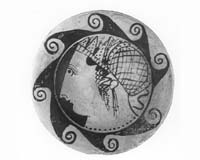
Stanford CA (SPX) May 31, 2006 For the first time, Stanford researchers have used novel statistical computer modeling to simulate demographic processes affecting the population of Tuscany over a 2,500-year time span. Rigorous tests used by the researchers have ruled out a genetic link between ancient Etruscans, the early inhabitants of central Italy, and the region's modern day residents. The findings suggest that something either suddenly wiped out the Etruscans or the group represented a social elite that had little in common with the people who became the true ancestors of Tuscans, said Joanna Mountain, assistant professor of anthropological sciences. "Very often, we assume the most simple explanation for something," said Mountain, an expert in anthropological genetics. "So when you find in a particular location the archeological remains of people, the simplest explanation is that those people are ancestral to whoever is living there now. How often do you get a chance to check that? Very rarely." The research advances the field of anthropological genetics by moving beyond simple storytelling about an ancient people to rigorous testing, using genetic data analysis, of a set of anthropological hypotheses, Mountain said. The findings are documented in "Serial Coalescent Simulations Suggest a Weak Genealogical Relationship Between Etruscans and Modern Tuscans," published May 15 in the online version of Proceedings of the National Academy of Sciences. Uma Ramakrishnan, a former Stanford postdoctoral fellow, and Elise M. S. Belle and Guido Barbujani of the University of Ferrara in Italy co-authored the paper with Mountain. As the paper details, previous extensive archeological excavations have established that Etruscan culture existed in central Italy between the eighth and second centuries B.C. Its origins are still controversial: Some ancient historians, including Herodotus (circa 430 B.C.), suggested that the Etruscans came to Italy from Asia Minor. But most modern archaeologists, along with Dionysius of Halicarnassos (circa 100 B.C.), believe that the Etruscan civilization developed locally from the 10th century B.C. Iron Age Villanovan culture. In the second century B.C., the Etruscans were given Roman citizenship, and soon afterward their language disappeared from records, the paper explains. "The Etruscans seem to be quite different in many ways from other ancient Italians, and archaeological evidence indicates that they spoke a non-Indo-European language," Mountain said. "Because of the cultural and linguistic shifts, scholars see the Etruscans as an enigma." The Etruscans are the only preclassical European population to date that has been genetically analyzed, Mountain said. Two years ago, Italian geneticists extracted maternally inherited mitochondrial DNA from the bones of 27 people called Etruscans found in six different necropolises (burial sites) in Tuscany. The female lineage was investigated because, unlike the male Y chromosome, many copies of mitochondrial DNA are found in each cell and thus are easier to extract, Mountain explained. The data represent one of the best collections of ancient human DNA in existence. "If you get DNA out of one bone, you can try to say something about the past," Mountain said. "But they managed to get DNA out of quite a few bones." The DNA of 49 people living in the region today was also sampled. Although data from the two groups revealed several differences, Mountain said, the researchers could not interpret if these were meaningful or significant. "What we did was address the question: Do the present-day people look like they could be descendents of the Etruscan population?" The answer surprised Mountain. "We did the simulation study and there was nothing we could do-we couldn't tweak it enough to get the modern people to look like they descended from the people in the Etruscan burial [sites]," she said. "We couldn't make it fit with the simple inheritance direct lineage model." The Stanford researchers used recently developed software called "Serial SimCoal" to simulate genetic data based on different population scenarios, such as small (25,000 females) or large (300,000 females) populations of constant size, an expanding population, and scenarios involving migration and selection. Despite the range of scenarios created, the scientists could not find a match between the observed archaeological data and the simulations. Christian Anderson, a former Stanford undergraduate, developed the software while working with Elizabeth Hadly, associate professor of biological sciences. She has used the approach to analyze the ancient DNA of small mammals. "I believe it's the first time it has been used to analyze ancient human DNA," Mountain said. "It's computationally intensive and requires DNA data from many individuals." The finding is important because it questions the common assumption that residents of a particular place are descendants of its earlier inhabitants, Mountain said. "Also, it raises a number of other questions-what happened to the Etruscans?" she said. "It's stimulating for archaeologists and other social scientists to look into what might have been the causes of this decline in the population. It may have been quite abrupt. Mostly, it's a matter of guessing." According to Mountain, the field of anthropological genetics is replete with such educated guesses. "There's so much storytelling that goes on in our field where people will see a particular genetic sequence and go, 'Aha! That means these people moved here and there,"' she said. "I tend to be fairly skeptical and say, 'That's a nice story.' Before [this study] you could tell a number of stories consistent with the data. What we've done is narrowed down these stories, which for me is a really great leap forward." Related Links Stanford University Mountain Laboratory
 When It Comes To Privacy Gender Matters
 Seattle WA (SPX) May 26, 2006
A study aimed at assessing perspectives about privacy in a public place - particularly when surveillance is not related to security - suggests women are more concerned than men, both as watcher and the watched. |
|
|

| The content herein, unless otherwise known to be public domain, are Copyright 1995-2006 - SpaceDaily.AFP and UPI Wire Stories are copyright Agence France-Presse and United Press International. ESA PortalReports are copyright European Space Agency. All NASA sourced material is public domain. Additionalcopyrights may apply in whole or part to other bona fide parties. Advertising does not imply endorsement,agreement or approval of any opinions, statements or information provided by SpaceDaily on any Web page published or hosted by SpaceDaily. Privacy Statement |