| . |  |
. |
| . | |
. |


Analysis: U.S. Wants No Change In Pakistan, Yet
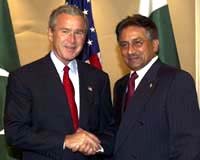
Washington (UPI) Mar 11, 2005 Three times this week, the Bush administration strongly supported Pakistan's military ruler Gen. Pervez Musharraf, quashing media speculations that Washington was persuading him to restore full democracy. The strongest declaration of support for Musharraf came from no less than President George W. Bush who said that Pakistan had made the United States "more secure" by arresting more than 100 militants across the country. In a policy speech delivered at the National Defense University in Washington Thursday, Bush counted Pakistan among one of the key allies in the U.S.-led "war on terror." "We're more secure because Pakistani forces captured more than 100 extremists across the country last year, including operatives who were plotting attacks against the United States," he said. A day earlier, Wh ite House Press Secretary Scott McClellan told a briefing in Washington that Pakistan was among the nations who were actively fighting terrorism. "The government of Pakistan is continuing to pursue elements of al-Qaida and the Taliban that operate along that border region between Afghanistan and Pakistan," he said. "They are continuing to stay on the offensive." In addition to this unprecedented declaration of support for Pakistan from the White House, the State Department said Wednesday Secretary of State Condoleezza Rice's forthcoming visit to Islamabad was intended to confirm Washington's "long-term engagement with Pakistan." Pakistan joined the "war on terror" after the Sept. 11, 2001, attacks in the United States, dumping its former Taliban allies and providing bases to U.S. forces for operations into Afghanistan. In March last year, Pakistan launched a major military offensive along the Afghan border. Hundreds of Pakistani troops and militants were killed and while Pakistan has officially declared the operation over, troops remain in the area and sporadic militant attacks on the troops also continue. This sudden change in Pakistan's attitude has annoyed al-Qaida and Taliban supporters who blame Musharraf for pushing the country away from its Islamic roots and "into the lap of the United States," as a recent al-Qaida statement said. In December 2003, the extremists organized two close attempts on Musharraf. He survived. But more than dozen security guards were killed when guerrillas rammed an explosive-laden car into his cavalcade. This continuous expression of U.S. support follows speculations in the Western and Pakistani media that Washington wants Musharraf to allow mainstream Pakistani political parties to operate freely and, if possible, also to give them some role in the government. The reports claimed that the Bush administration was getting increasingly worried that the absence of two mainstream political parties -- the Pakistan People's Party and the Pakistan Muslim League (N) -- had left the field open to religious extremists. Pakistani religious parties formed an alliance before the 2002 elections called the Muttahida Majlis-e-Amal and won enough seats to become the second largest group in the Parliament. In all previous elections, religious parties performed so poorly that they never won more than 10 seats in a house of 210. Pakistani political analysts attribute MMA's success to the curbs placed on mainstream political parties. Leaders of both the PPP and PML (N) -- former prime ministers Benazir Bhutto and Nawaz Sharif -- lived in exile and were not allowed to return home and campaign for their candidates in the 2002 elections. Since then the MMA has formed government in a key strategic pr ovince bordering Afghanistan and is a coalition partner in another. Liberal political activists in Pakistan complain that the absence of leaders like Bhutto and Sharif is allowing the MMA to further consolidate its position. "They are working at neighborhood levels, helping people get water, electricity and medical facilities, helping them deal with their day-to-day problems," says Naveed Ahmad, a political analyst for a Pakistani daily, The News. "It definitely helps in getting recognition, and the MMA hopes this will help win more seats in the next elections scheduled in 2007." It was against this backdrop that Pakistani politicians sat up and noticed last month when the U.S. State Department backed the demand for Musharraf to give up one of the two official positions he holds. Musharraf, who as army chief toppled Sharif in October 1999, has retained the posts of the army chief as well as that of the president despit e having agreed last year to retire from the army by December 2004. Endorsing a statement by the Commonwealth of former British colonies for Musharraf to leave the army, State Department spokesman Richard Boucher said, "We think it would be a good step for him to do that." He also said that the United States would like the 2007 elections to meet "international standards" and have "the full participation of all political parties." The statement encouraged Bhutto to seek a meeting with Rice during a visit to Washington last week. Although Bhutto met a mid-level official at the National Security Council, she could not meet Rice. This obviously was a disappointment for her party activists who had hoped that Bhutto's visit would lead to a greater cooperation between the United States and Pakistani political parties. And this week's three forceful statements praising the Musharraf government makes it even more obvious that America is not interested in a political change in Pakistan, at least not yet. Related Links SpaceDaily Search SpaceDaily Subscribe To SpaceDaily Express
 US Not An Example For Nuclear Non-Proliferation: Sam Nunn
 Washington (AFP) Mar 09, 2005
US President George W. Bush has not set an example to persuade allies to join nuclear non-proliferation efforts in Iran and North Korea, former US senator Sam Nunn said Wednesday. |
|
|

| The content herein, unless otherwise known to be public domain, are Copyright 1995-2006 - SpaceDaily.AFP and UPI Wire Stories are copyright Agence France-Presse and United Press International. ESA PortalReports are copyright European Space Agency. All NASA sourced material is public domain. Additionalcopyrights may apply in whole or part to other bona fide parties. Advertising does not imply endorsement,agreement or approval of any opinions, statements or information provided by SpaceDaily on any Web page published or hosted by SpaceDaily. Privacy Statement |