| . |  |
. |
| . | |
. |


Analysis: Tough Deal Await Korean Nuke Negotiators
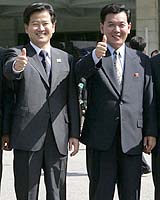
Seoul (UPI) Sep 21, 2005 South Korean officials seemed excited Tuesday with a major breakthrough in the three-year standoff over North Korea's nuclear weapons programs. Unification Minister Chung Dong-young, the country's top security policymaker as the chief of the presidential National Security Council, described Monday's nuclear agreement as a "diplomatic triumph" for South Korea, which made "all-out" efforts to seek a compromise in the nuclear stalemate. President Roh Moo-hyun convened a Cabinet meeting to praise the outcome of the six-nation talks and called for follow-up measures to resolve the nuclear standoff. In the meeting, Roh welcomed the agreement as "epoch-making" in resolving the nuclear crisis. "The adoption of the joint statement in the fourth round of the six-party talks heralded a crucial opportunity to resolve the North's nuclear issue," he said. Roh also ordered the Cabinet to seek "comprehensive" measures to help North Korea rebuild its tattered economy to back up the nuclear disarmament agreement. "North Korea urgently needs rice and fertilizer at the moment, but energy, logistics and telecommunications infrastructure are important in the long term," he said. He plans to hold a an evening banquet for security officials and delegates to the six-party talked that ended on Monday in Beijing with a six-point agreement highlighted by North Korea's promise to abandon all of its nuclear programs. South Korean officials expect the agreement would also pave the way for the establishment of a peace regime on the Korean peninsula to replace the current armistice mechanism that ended the 1950-53 Korean War, which would induce more foreign investment in South Korea that has suffered from geopolitical risks. Seoul's shares sharply rose to an all-time high Tuesday as investor sentiment was cheered by the agreement. Economy officials expected international ratings agencies to upgrade South Korea's credit ratings on the back of the nuclear breakthrough. But Seoul's optimism may be short-lived as North Korea threw the nuclear deal into doubt as it declared it will not scrap its nuclear programs and not return to the nonproliferation regime before it is given light-water nuclear reactors. "The United States should not even dream of the issue of the DPRK (North Korea)'s dismantlement of its nuclear deterrent before providing LWRs (light-water reactors), a physical guarantee for confidence-building," the North's Foreign Ministry said in a statement. "What is most essential is, therefore, for the United States to provide LWRs to the DPRK as soon as possible as evidence proving the (U.S.'s) substantial recognition of the DPRK's nuclear activity for a peaceful purpose," said the statement carried by the North's official Korean Central News Agency. "As clarified in the joint statement, we will return to the Nuclear Nonproliferation Treaty and sign the Safeguards Agreement with the International Atomic Energy Agency and comply with it immediately upon the U.S. provision of light-water reactors, a basis of confidence-building, to us," it said. Kim Kye Gwan, the North's top negotiator to the six-party talks, also said his country will not act until the United States demonstrates that its hostile policy toward the North has ended. "They (Americans) are telling us to give up everything but there will be no such thing as giving it up first," Kim told reporters in Beijing just ahead of returning home. The North's demand comes less than a day after the accord under which it would abandon all of its nuclear programs. North Korea "committed to abandoning all nuclear weapons and existing nuclear programs and returning at an early date to the treaty on the nonproliferation of nuclear weapons and to IAEA safeguards," according to the joint statement. In return, the five other nations - the United States, China, Japan, Russia and South Korea - agreed to discuss the provision of light-water reactors to North Korea "at an appropriate time." The United States and South Korea clarified that they would discuss the nuclear reactor issue only after Pyongyang gets back into the NPT and gets IAEA safeguards. "When you have verifiable denuclearization of the Korean peninsula and the North Koreans are nuclear-free, then I think we can probably discuss just about anything," U.S. Secretary of State Condoleezza Rice said in New York. In Seoul, Vice Foreign Minister Lee Tae-sik said North Korea can get nuclear reactors only after it rejoined NPT and complied with safeguards agreement. Analysts here say the joint statement is just a first step to settle the nuclear issue and there will be many twists and turns until we find a final resolution. "We don't have to become too excited, as it's too early to pop open champagne," said Prof. Nam Joo-hong, a political scientist at Kyonggi University in Seoul. The six nations would face even tougher negotiations on implementation and other details in the next round of talks in November, Nam and other analysts say. All rights reserved. Copyright 2004 by United Press International. Sections of the information displayed on this page (dispatches, photographs, logos) are protected by intellectual property rights owned by United Press International. As a consequence, you may not copy, reproduce, modify, transmit, publish, display or in any way commercially exploit any of the content of this section without the prior written consent of by United Press International. Related Links SpaceDaily Search SpaceDaily Subscribe To SpaceDaily Express
 Annan Opens Nuclear Test Ban Meeting, Urges Swift Signing, Ratification
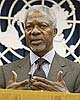 United Nations (AFP) Sep 21, 2005
UN chief Kofi Annan opened a review conference on the nuclear test ban treaty here Wednesday, urging states which have not yet signed or ratified it to do so without delay and lamenting the world's failure to tackle disarmament. |
|
|

| The content herein, unless otherwise known to be public domain, are Copyright 1995-2006 - SpaceDaily.AFP and UPI Wire Stories are copyright Agence France-Presse and United Press International. ESA PortalReports are copyright European Space Agency. All NASA sourced material is public domain. Additionalcopyrights may apply in whole or part to other bona fide parties. Advertising does not imply endorsement,agreement or approval of any opinions, statements or information provided by SpaceDaily on any Web page published or hosted by SpaceDaily. Privacy Statement |