| . |  |
. |
| . | |
. |


Analysis: Nuclear Future Coming Together?
Washington DC (UPI) Feb 28, 2005 Representatives of the United States, Japan and Europe will sign an agreement Monday that, in a best-case scenario, will lead to a future in which nuclear power is seen as a boon to the environment and less of a risk to world security. Known as the International Forum Framework Agreement, the pact being signed at the French Embassy in Washington will encourage further technical research into the development of the next generation of reactors on which a possible renaissance in nuclear power will be based. "Nuclear technology can play a key role in the future by providing a means of supplying people all over the world with a safe, proliferation-resistant, and economic means of producing electricity -- and eventually hydrogen -- without harming the environment in which we all live and breathe," the Energy Department declared in a tidy summation of the so-called Gene ration IV Nuclear Energy System. Generation IV is a collection of a half-dozen designs for different types of reactors. The names will likely ring a bell with engineering types: lead-cooled fast-reactor system, molten-salt reactor, super-critical water-cooled reactor system, and so on. These designs, however, are all pointed at replacing aging reactors starting in 2030 and fostering a resurrection of an industry that has been stalled since the 1970s, even though it is capable of generating large amounts of electricity with virtually nothing in the way of emissions that can pollute the air or aggravate the problem of global warming. The 2030 timetable is not unreasonably long when considering the enormous lead time needed to complete the design work and draw-up plans for actual electricity-generating plants. The argument for the Generation IV program, which was slated for about $45 million in the current U.S. budget, also includes the intriguing lure of the hydrogen highway. One of the main knocks against the vision of wide-scale use of hydrogen-powered cars is that it takes a lot of energy to produce hydrogen, which currently translates to the need for more coal and natural-gas power plants to meet the inevitable demand. As envisioned by the Bush administration, that Catch-22 would be busted by Generation IV power plants producing hydrogen as well as electricity. "We believe that for the future, Very-High-Temperature Reactors coupled with thermo-chemical or high-temperature electrolytic water splitting processes offers a more efficient technology for production of large quantities of hydrogen without release of greenhouse gases," William D. Magwood, director of the Energy Department's Office of Nuclear Energy Science and Technology, explained to a House Science Committee subcommittee last year. Undoubtedly easier said th an done, the development and deployment of Generation IV would nevertheless change the energy and environmental landscape if it performs as advertised. At the same time, it seeks, but does not guarantee, to further remove nuclear power plants as a source of radioactive waste that a rogue nation could convert into the business end of a weapon of mass destruction. There is no technology inherent in the Generation IV designs currently under development that will provide some great leap forward in removing nuclear power plants from the nuclear weapons arena. Instead, it builds on the kind of "best-available technology" strategy that the Department of Energy states has forced nuclear club gate-crashers to create from their own weapons-grade material rather than simply hauling it out of a power plant. "This does not mean that nuclear fuel cycles are, or can be, proliferation proof," the department states in its Backgrounder on Generation IV. "Rather, the civilian nuclear fuel cycle has a history of being a less desirable route for production of weapons-usable materials. Generation IV nuclear energy systems should continue being highly resistant to proliferation and minimize the risk of proliferation by their operation." In other words, curbing nuclear proliferation at the power-plant level can be achieved to some extent through reactor designs, with the primary responsibility left to the people who operate the plants and those who provide security for them. That conclusion is far from a panacea for those who see the current nuclear developments in North Korea and Iran as a budding disaster; however, it can be put in the same context as the Bush plan to reduce power-plant emissions of mercury: a little something now is better than nothing at all. So the benefits of Generation IV remain a seductive attraction, particularly when energy analysts ar e unanimous in their forecasts of steadily increasing global energy demand that will someday soon reach the point that the supply of recoverable fossil fuel simply cannot meet, and renewable energy and conservation hits a wall. Plenty of daunting obstacles remain for nuclear power's expansion. Plants are big and expensive and must be competitive in terms of price with coal and gas. In addition, Chernobyl and Three Mile Island remain frightening reminders of the consequences of when things go wrong. Nevertheless, nuclear power appears to have a role in the future whether the world likes it or not, and Monday's signing ceremony will mark a step forward in making that role as productive as possible. Related Links SpaceDaily Search SpaceDaily Subscribe To SpaceDaily Express
 Analysis: Giant Rig Offers New Technology
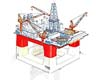 Dallas TX (UPI) Feb 28, 2005
Bush administration officials say the world's largest and most advanced offshore oil platform displays the technology that will make it possible to tap into oil and gas reserves that were previously inaccessible. |
|
|

| The content herein, unless otherwise known to be public domain, are Copyright 1995-2006 - SpaceDaily.AFP and UPI Wire Stories are copyright Agence France-Presse and United Press International. ESA PortalReports are copyright European Space Agency. All NASA sourced material is public domain. Additionalcopyrights may apply in whole or part to other bona fide parties. Advertising does not imply endorsement,agreement or approval of any opinions, statements or information provided by SpaceDaily on any Web page published or hosted by SpaceDaily. Privacy Statement |