| . |  |
. |
| . | |
. |


Analysis: Missile Test Will Fuel Arms Race
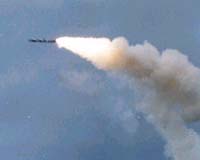
New Delhi (UPI) Aug 12, 2005 The successful test firing of a cruise missile by Pakistan on Thursday will accelerate the arms race in South Asia, but the test was likely a reply to India's own supersonic cruise missile BrahMos that was test fired in 2001, Indian defense analysts said Friday. "The testing of a cruise missile by Pakistan will accelerate the nuclear arms race in South Asia," said Anil Chakraborty, a defense and strategy analyst. He said the test was more political than military and signaled to New Delhi that Pakistan had joined those select countries that have the capability to develop a cruise missile. Pakistan Thursday tested its first ground-launched cruise missile, which can carry conventional and nuclear warheads. Despite signing an agreement last weekend with India on prior notification ahead of nuclear tests, Islamabad did not inform New Delhi, saying the deal covered only ballistic and not cruise missiles. A Pakistani military statement issued after the testing said the Babar - named for the first Mughal emperor -- had a range of 300 miles. President Gen. Pervez Musharraf hailed the test as a milestone in Pakistan's quest to strengthen and consolidate its strategic capability. Islamabad said the test improved military balance with India. India has not made its own cruise missile. The Indo-Russian BrahMos is based on the airframe of the Yakhont supersonic anti-ship cruise missile. It's an anti-ship missile that can be launched from submarine, aircraft and land-based launchers. "Given the Chinese origin of Pakistan's ballistic missile program, it would be safe to assume that there was a Beijing connection to Thursday test," said Manor Joshi, a senior Indian journalist and an expert on defense and strategic affairs. He said Chinese cruise missiles are dangerous weapons because with their small engines and low-flight profile, they penetrate radar and infrared detection networks. India and Pakistan became nuclear powers after conducting nuclear tests in 1998, but Pakistan's ability to detonate nuclear devices was widely suspected before its May 28, 1998, tests. Pakistan has built, with clandestine Chinese assistance, a 40 MW heavy water reactor at Khushab to feed its nuclear plants at Rawalpindi. The reactor, which began operating in 1999, is Islamabad's only source of Plutonium-bearing spent fuel that is not under international safeguards. The Khushab reactor could also produce tritium for boosted nuclear weapons or a hydrogen bomb. India did not respond to the test, however. "New Delhi is not expected to react against the test as it seems not going to be controversial because it has not been conducted in a 'provocative' manner," said Ajai Sahani, executive director of Center for Conflict Management, a New Delhi-based think tank. Reacting to Pakistan's test, the United States said it was conducted in a way that way not "provocative." "You know it's important to us that actions by states on the subcontinent are done in ways that aren't provocative, in ways that aren't threatening. I think that by all accounts that test met that criteria and I'd leave it at that," U.S. State Department deputy spokesman Adam Ereli said Thursday. The test also follows last month's deal between the United States and India in which Washington recognized India as a "responsible nuclear power" and agreed to supply it with civilian nuclear technology. The deal was criticized in Pakistan. Cruise missiles are unmanned aircraft that travel at sub-sonic speed and often use a jet-propulsion system. They can carry a conventional or nuclear warhead many hundreds of miles with high accuracy. It is self-navigating and flies low to avoid radar. Related Links SpaceDaily Search SpaceDaily Subscribe To SpaceDaily Express
 Lockheed Martin Study Develops Cost-Cutting Solutions For LAM Production
 Dallas TX (SPX) Aug 12, 2005
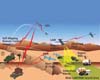
Lockheed Martin has completed two aggressive cost reduction workshops for the Non Line-of-Sight � Launch System (NLOS-LS) Loitering Attack Missile (LAM), resulting in the reduction of the missile assembly time of the current System Design and Development (SDD) baseline configuration from 21.4 hours to 1.6 hours, a reduction of more than 90 percent. |
|
|

| The content herein, unless otherwise known to be public domain, are Copyright 1995-2006 - SpaceDaily.AFP and UPI Wire Stories are copyright Agence France-Presse and United Press International. ESA PortalReports are copyright European Space Agency. All NASA sourced material is public domain. Additionalcopyrights may apply in whole or part to other bona fide parties. Advertising does not imply endorsement,agreement or approval of any opinions, statements or information provided by SpaceDaily on any Web page published or hosted by SpaceDaily. Privacy Statement |