| . |  |
. |
| . | |
. |


Analysis: Iran Defiant On Nuclear Power
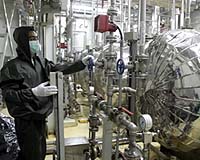
Washington (UPI) Sep 21, 2005 Iranian President Mahmoud Ahmadinejad's defiant message in the United Nations that his country had an "inalienable right" to press ahead with its nuclear program was hammered home Tuesday by Tehran's chief nuclear negotiator. Uranium enrichment would be resumed and the U.N. inspectors would be shut out if the West used "the language of force." The negotiator's warning appeared to be Iran's immediate response to two developments. One was a draft resolution submitted to the International Atomic Energy Agency, the U.N. nuclear watchdog, calling on the Security Council to take up "Iran's many failures and breaches of its obligations." The other was the agreement reached this week in the six-party talks hosted by China whereby North Korea is to scrap its nuclear weapons and halt its existing nuclear programs. The deal, which leaves several loose ends, in effect recognizes Pyongyang's right to develop peaceful nuclear technology. Both the IAEA's boss, Mohammad ElBaradei, and British Foreign Secretary Jack Straw had called on Iran to "follow" the North Korean example. But the response of Ali Larijani, the new, hard-line secretary of Tehran's Supreme Council on National Security which supervises negotiations on the nuclear issue, was to argue that what was good enough for North Korea ought to be good enough for Iran. "We see now that America and Europe got almost nothing from the talks (with Pyongyang) except that North Korea announced it would not produce nuclear weapons, something we have always said, repeated and reiterated," Larijani said. "After years of negotiations you (in this case the United States, China, South Korea, Russia, and Japan) ended up accepting North Korea's rights. Why not also accept ours now?" Basing its charges on intelligence information and claims by Iranian dissidents, the Bush administration asserts that Iran has jeopardized its right as a signatory of the Nuclear Nonproliferation Treaty to develop a nuclear program for peaceful means by also secretly enriching uranium, which can be a step towards producing nuclear weapons. The IAEA found that Iran has hidden aspects of its civilian nuclear energy program from international inspectors, but has not found any concrete evidence that Iran has an illicit nuclear weapons program. Washington believes that it has the necessary 18 votes in the IAEA's 35-nation board of governors to refer the matter to the Security Council, which could impose sanctions. In addition to 11 European members the resolution is said to be backed by -- among others -- the United States, South Korea, Australia, Japan, Argentina, and Peru. Still, the United States and the three European negotiators - known as the EU3 -- would like the largest possible support as a show of strength going into the Security Council. However, what happens in the council remains uncertain, with Russia and China -- two of the five permanent members -- so far openly opposed to U.N. censure. Iran is using the economic leverage at its disposal to cultivate influential countries, such as India. Speaking at a press conference in Tehran, Larijani said bluntly that he regretted that "countries with economic ties with Iran, particularly in the petroleum area, have so far not defended Iran's rights." Russia is helping Iran to build an $800 million commercial light-water nuclear reactor at Bushehr, a southwestern Iranian city on the Persian Gulf coast. China and India are major clients of Iranian oil. Earlier this year, Iran and India finalized plans to build a 1,000-mile natural gas pipeline from the Iranian port of Assaluyah through Pakistan to the Indian state of Rajastan. Aside from the negative diplomatic fallout from what appears to be a dubious deal with North Korea, the Bush administration's diplomatic efforts to build a plausible case against Iran at last week's U.N. summit had limited impact. "The United States hasn't done a good job explaining why Iran has to be referred to the Security Council," says Jon Wolfsthal, nonproliferation fellow at the Council for Strategic and International Studies. "In addition, it has a huge credibility gap because of Iraq, and a consistency gap because it's trying to treat Iran differently from how it treats other countries with nuclear ambitions, like India, North Korea, and Brazil." Wolfsthal believes the United States "lost ground on North Korea. The fact that the United States has recognized, in theory, North Korea's right to have peaceful nuclear technology makes it harder to argue that Iran can't have it." At the United Nations last week, Washington diplomats frequently ran into the view that the diplomatic options for solving the crisis are not yet exhausted. The next step, many countries feel, is for the U.S. officials to engage Iran -- negotiating and offering incentives, instead of threatening it. So far, however, the Bush administration has shown no interest in taking that step. Related Links SpaceDaily Search SpaceDaily Subscribe To SpaceDaily Express
 Annan Opens Nuclear Test Ban Meeting, Urges Swift Signing, Ratification
 United Nations (AFP) Sep 21, 2005
UN chief Kofi Annan opened a review conference on the nuclear test ban treaty here Wednesday, urging states which have not yet signed or ratified it to do so without delay and lamenting the world's failure to tackle disarmament. |
|
|

| The content herein, unless otherwise known to be public domain, are Copyright 1995-2006 - SpaceDaily.AFP and UPI Wire Stories are copyright Agence France-Presse and United Press International. ESA PortalReports are copyright European Space Agency. All NASA sourced material is public domain. Additionalcopyrights may apply in whole or part to other bona fide parties. Advertising does not imply endorsement,agreement or approval of any opinions, statements or information provided by SpaceDaily on any Web page published or hosted by SpaceDaily. Privacy Statement |