| . |  |
. |
| . | |
. |


Analysis: Baghdad's Day Of Hell
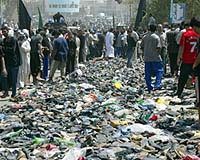
Baghdad (UPI) Aug 31, 2005 Wednesday's disaster of biblical proportion in Baghdad claimed the lives of more than 650 Shiites conjuring images of hell's inferno in what was once thought to be the Garden of Eden -- the land between the two rivers, the Tigris and the Euphrates. The ghastly scene of trampled bodies suffocating to death, however, is as far removed from the Garden of Eden as can be imagined. It all started with a procession of Shiite pilgrims celebrating the martyrdom of Imam Mousa al-Kazim, a revered religious figure among Shiites. The pilgrims were making their way to the mausoleum during an annual ceremony when mortar rounds were fired on the edifice killing about 10 people. The situation rapidly escalated when rumors circulated among the thousands of people packed on the Khazimiyah Bridge that suicide bombers were among the crowd and were about to blow themselves up. According to local television reports, about 1 millions pilgrims from Baghdad and outlying provinces had gathered near the Imam Mousa al-Kadim shrine. Panic erupted as people pushed and shoved, trying to get off the bridge. A stampede ensued in which hundreds of Shiite pilgrims died. Many more perished when part of the bridge's railings gave way under pressure from the crowd and scores of people fell into the Tigris River. Iraqi security sources and eyewitnesses said more than 575 people, including women, were killed in the stampede. There was no immediate estimate of the number of injured, who are expected to be in the hundreds. Lack of proper security measures by the U.S. and Iraqi forces, rumors of suicide bombers in the area, explosions and reports of poisoned food among some pilgrims who ate contaminated meat are all elements that contributed to the tragic events. Iraqi security forces had taken unprecedented measures since early Wednesday morning to facilitate the procession of the pilgrims whose number this year by far exceeded those of previous years. Thousands have come from cities all over Iraq to participate in the ceremony, including Basra in the south and the central Iraq Shiite centers of Najaf and Kerbala. This is the deadliest single incident since the U.S.-led war on Iraq began in 2003. Iraqi Health Ministry officials say the death toll could climb to 1,000. A three-day mourning period was immediately declared by Iraq's Prime Minister Ibrahim al-Jaafari who set up a special committee to investigate the stampede. A source told United Press International the investigating committee includes a number of high-ranking political and security officials who already have inspected the scene on the bridge leading to Kazimiyah in northern Baghdad. Iraqi Health Minister Abdel Mutlib Ali blamed the tragic incident on the U.S. forces as well as the Iraqi ministers of defense and interior because they failed to take the appropriate security measures to protect the pilgrims. "Every Iraqi will demand holding the occupation forces and the ministers of defense and interior responsible for the security, seeing they were aware of the ceremony date," said Ali, noting the concerned ministries should have taken "security precautions ... and guarantee safe passageways" for the thousands of Shiite pilgrims. Ali said the Iraqi Health Ministry took some measures but was not expecting "such big losses." The minister however refused to confirm reports that some died because of poisoned food and drinks offered to them by "suspected terrorists" while on their way to the sacred shrine. Iraqi police took unprecedented security measures to facilitate the procession of the pilgrims, whose numbers this year greatly exceeded those of previous years. Thousands of heavily armed soldiers and policemen were deployed in streets and squares leading to the mausoleum and mosque of Imam Mousa al-Kazim. Thousands flocked from the Shiite cities of Mosul, Samawa, Najaf, Karbala and others; many of who came on foot in a tradition meant to show love and respect to their imams. During the march to the Imam Kazem mausoleum, thousands shouted, "Sadr is the leader and Badr is the Mujahed" -- in reference to young Shiite leader Moqtada al-Sadr and the Badr Brigade of the Supreme Assembly of the Islamic Revolution in Iraq. Such slogans and the huge number of pilgrims gave this year's ceremony a political flavor and was more of a show of force, according to a political observer in Baghdad. The stampede comes amid fears of a possible break-up of Iraq over differences among the country's Sunnis, Shiites and Kurds over the proposed constitution over federalism, which practically leaves the Sunnis with the poorer center part of Iraq where there is no oil. Iraq's Interior Minister Bayan Jabr Solag warned of attempts to incite "confessional discord among the Iraqi people" and said "Arabs, Kurds, Sunnis and Shiites are all one hand working together for the sake of a unified Iraq." Solag denied Wednesday's stampede was "an arranged action" targeting Shiite pilgrims and argued, "protecting 3 million people in a terrorist climate is not an easy matter." This is not the first time Shiite shrines are targeted during religious festivals presumably be Sunni extremists, hoping to ignite a civil war. Last March unknown attackers hit the holy site in Karbala, killing more than 180 people. Last years 1,000 Muslim pilgrims perished in a similar stampede during the annual pilgrimage in the holy Saudi city of Mecca. Related Links SpaceDaily Search SpaceDaily Subscribe To SpaceDaily Express
 Kurdish Dohuk: The Face Of Iraq's Future?
 Dohuk City, Iraq (UPI) Aug 30, 2005
Dohuk province, in northwestern Iraq, is a place apart. The Kurdish-majority area of which it is a part was protected for nearly 15 years from Saddam Hussein's forces by the U.S.-enforced no-fly zone. Those buffer years allowed a democracy to get up on its legs. |
|
|

| The content herein, unless otherwise known to be public domain, are Copyright 1995-2006 - SpaceDaily.AFP and UPI Wire Stories are copyright Agence France-Presse and United Press International. ESA PortalReports are copyright European Space Agency. All NASA sourced material is public domain. Additionalcopyrights may apply in whole or part to other bona fide parties. Advertising does not imply endorsement,agreement or approval of any opinions, statements or information provided by SpaceDaily on any Web page published or hosted by SpaceDaily. Privacy Statement |