| . |  |
. |
| . | |
. |


Analysis: A Volcano's Most Public Eruption
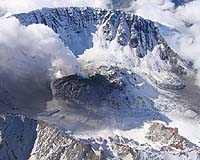
San Francisco (UPI) Dec 20, 2004 There are several, highly unusual aspects of the 2004 eruption of Mount St. Helens, but perhaps the most extraordinary is how scientists and interested lay people worldwide are getting to watch it happen up close in real time. The new eruption, which began in October, is quite possibly the most publicly visible volcanic event ever, said Steve Malone, a geophysics researcher with the Pacific Northwest Seismograph Network in Seattle. One bit of supporting evidence: The Web site for the U.S. Geological Survey's Cascades Volcano Observatory in Vancouver, Wash. has recorded almost 50 million visits since the latest eruption began. Most of those hits occurred in October, when the mountain began exhibiting worrisome signs of another major eruption. Likewise, every day, many thousands of people from around the world visited the Observatory's VolcanoCam. It is a Web camera planted only a few miles away from the maw of the crater, giving updated images every five minutes, day and night, (mostly) rain or shine, of developments on the mountain. Eventually, the signs of something major died down and the public's attention naturally turned away, but according to the scientists watching Mount St. Helens, the volcano still is plenty active and what it is doing is amazing. There's a truckload of hot rock coming out of the ground every second, said Dan Dzurisin, with the Cascades observatory. He and colleagues briefed reporters on the latest from Mount St. Helens at the American Geophysical Union's annual meeting. Dzurisin, who has stood inside the crater recently to plant some of the elaborate sensors gathering constant information about the volcano's activity, gave the current eruption some perspective. He said after the catastrophic eruption in May 1980, in which most of the top of the volcano's cone essentially blew off, Mount St. Helens settled back into a relatively quiet period. It grew a small new lava dome in the center of the crater, but took six years to do it. Then, for the next 17 years or so, the volcano quieted down again, and even allowed a 600-foot-thick glacier to form inside the crater that buried the dome. Now, Dzurisin said, the mountain has formed a new dome that dwarfs the older one, and has done it in about six weeks. The dome is about 1,200 feet long, almost 750 feet wide and has grown to 600 feet tall. It is bigger than, though roughly the shape of, a USS Nimitz-class aircraft carrier turned on its side. Because of the activity and rapid changes, the scientists watching Mount St. Helens are taking extraordinary precautions anytime they visit the crater. For one thing, Dzurisin told United Press International, they all remember what happened to their colleague Stan Williams of Arizona State University. In 1993, Williams and nine others were standing inside Galeras, a volcano in Colombia, when it suddenly erupted. Everyone else was killed and Williams was badly injured. Now, when anyone attempts to set foot inside Mount St. Helens, they are in constant radio contact with colleagues who are glued to the instrument screens and seismic monitors. They are prepared to drop what they are doing and leave at a moment's notice. The team also is using an extensive array of remote sensors, including simple devices they call spiders, which are either global positioning system transmitters or seismic recorders attached to what Dzurisin calls a box full of batteries with a radio and antenna. They fly the spiders in and position them all around the crater using long ropes from helicopters. They also are deploying small fleets of pilotless aircraft and robotic surface vehicles in a prototype effort at remote close-up video. They are even using jury-rigged ocean dredges - also slung from helicopters - to collect samples from the top of the dome. What they collect is very hot - about 1,600 degrees Fahrenheit (875 degrees Celsius). It also contains more crystallized silica than the older dome, something that has led the volcanologists to speculate about what is going on deep in the Earth below the mountain. Something extraordinary is happening, Dzurisin said. Lava is rising as if through a hot soda straw, he said, running from several miles down up under the new dome, but turned sideways at the top. That is why the dome has been pushing outward, although it still is elevating as well, at a rate of a millimeter or so per minute - each millimeter accompanied by a small earthquake. When the new dome first appeared, Dzurisin explained, it moved south until it hit the crater wall, then turned and abutted the crater on the western side. Now it is bulldozing toward the north, melting and moving the glacier aside. We're wondering what it's going to do next, he said. Despite its outer rocky layer, which is about 30 feet thick, the dome's molten lava renders it quite wiggly, like crusty jello - except this jello could melt most metals. The question that remains is whether - and when - the volcano will blow its top again. The answer, according to John Pallister, another member of the Cascades Volcano Observatory team, is uncertain. There's a whole range of events in its history, he said. It turns out Mount St. Helens is a relative young volcano - only about 100,000 years old. For most of its history, it has been fairly regular, posting a major eruption about every hundred years or so. Given that the last one was 24 years ago, it would seem unlikely the mountain is headed for a major one right now. That does not mean a major event is out of the question. The volcano is in a steady state now, Pallister said, but you could say a runaway train was in a steady state, too. Nothing might be happening now but you know something is going to. Whatever happens, the mountain's new burst of activity is generating volumes of new data that have vastly improved the understanding of volcanoes. In terms of understanding what happened in 1980 vs. what is happening now, technology has made (the events) a century apart, said Cynthia Gardner of the Cascades team. Good thing, because the effects of the last eruption were deadly as well as devastating, something that can occur with volcanoes when they act unexpectedly. Though the surrounding population has been chastened by the 1980 event, the danger remains, not so much from pryoclastic flows and lahars anymore - respectively, the explosive and extremely hot ash clouds, which can travel hundreds of miles an hour, and the massive mudslides caused when hot lava meets abundant glacier ice - but from ash clouds that can bring down jet airliners if pilots enter them unsuspectingly. Improved understanding of the subterranean processes could help predict such an eventuality, Pallister said. Mount St. Helens has been beautifully studied over the last 20 to 30 years, he said. It has led to a quantum breakthrough in the scientific knowledge of the mountain. Related Links SpaceDaily Search SpaceDaily Subscribe To SpaceDaily Express
 Diving For Life Under Antarctic Ice
 Moffett Field CA (SPX) Dec 16, 2004
Dale Andersen is a biologist at McGill University, the SETI Institute and NASA Ames. His research focuses on Mars analogs, locations on Earth that resemble Mars in one or more ways. |
|
|

| The content herein, unless otherwise known to be public domain, are Copyright 1995-2006 - SpaceDaily.AFP and UPI Wire Stories are copyright Agence France-Presse and United Press International. ESA PortalReports are copyright European Space Agency. All NASA sourced material is public domain. Additionalcopyrights may apply in whole or part to other bona fide parties. Advertising does not imply endorsement,agreement or approval of any opinions, statements or information provided by SpaceDaily on any Web page published or hosted by SpaceDaily. Privacy Statement |