| . |  |
. |
| . | |
. |


 by Staff Writers Leioa, Spain (SPX) Feb 04, 2021
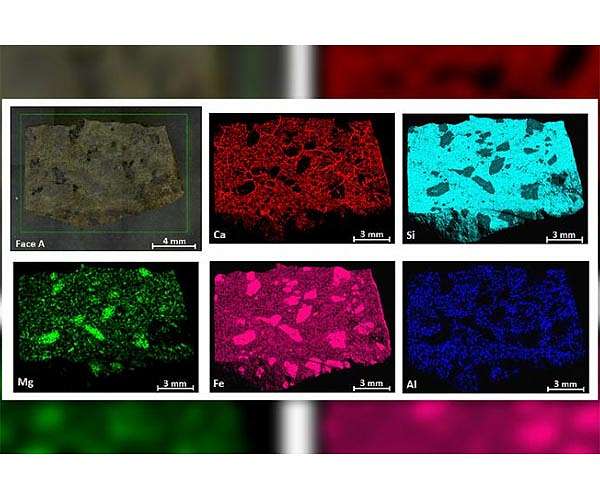
The IBeA research group from the University of the Basque Country's Department of Analytical Chemistry, Faculty of Science and Technology, is participating in NASA's Mars2020 space mission, which is scheduled to touch down on Mars in February this year. Specifically, the group has participated in constructing and verifying the chemical homogeneity of the templates included on the calibration card of the SuperCam instrument mounted on the Perseverance. 'We made a set of pads perfectly characterised in accordance the instruments we have here, in order to enable us to verify that the LIBS and Raman spectroscopy measurements taken by the SuperCam are correct,' explains Doctor Cristina Garcia-Florentino. 'Raman spectroscopy is a technique for determining the molecular composition of unknown samples,' she continues. 'In other words, not only can we determine, for example, whether the sample contains calcium or iron, etc., we can also identify the molecular form in which they are present. Thus, we can see whether they contain calcite or gypsum, for example. We can determine the geochemical composition of the planet'. At the same time, the research group is also working on characterising meteorites, with a twofold objective: 'Firstly, to get ready for the information that may be sent from Mars by the Perseverance rover; and secondly, to develop non-destructive analytical strategies for characterising Martian samples from the return mission (Mars Sample Return mission) when it reaches Earth'. To date, Martian meteorites have been the only Martian samples available for developing different analysis methods. In a recent study, the group has proposed an innovative non-destructive analytical strategy that could be added to the current arsenal of fast analysis techniques which can be used with future samples. To demonstrate its capabilities, the group has used their analytical proposal to 'characterise the Martian meteorite Dar al Gani 735, with the aim of identifying the terrestrial and non-terrestrial alterations suffered by it, as a very valuable complementary methodology to the more traditional petrographic analyses,' explains Dr Garcia-Florentino.
Access may be uncertain According to Dr Garcia-Florentino, the technique is important 'because, once we have samples brought back directly from Mars, we cannot destroy them to analyse them in the initial stages of study. It is therefore important to be ready for when the Martian samples arrive, in order to gain as much information from them as possible, with the fewest possible errors and trying to destroy them as little as possible'. Nevertheless, the researcher warns that access to the information and to the samples themselves will be difficult: 'We still do not know whether we will be granted access to the samples, whether they will allow us to analyse them as we propose here with the techniques we have developed'. Meanwhile, the IBeA group will continue its work, 'because each meteorite is a world unto itself; each meteorite is totally different from all others'.
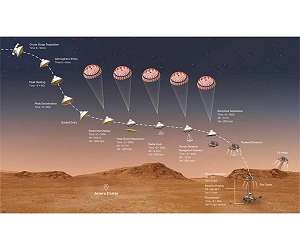
NASA's Perseverance Rover 22 days from Mars landing Pasadena CA (JPL) Jan 28, 2021 NASA's Mars 2020 Perseverance rover mission is just 22 days from landing on the surface of Mars. The spacecraft has about 25.6 million miles (41.2M km) remaining in its 292.5-million-mile (470.8M km) journey and is currently closing that distance at 1.6 miles per second (2.5 kilometers per second). Once at the top of the Red Planet's atmosphere, an action-packed seven minutes of descent awaits - complete with temperatures equivalent to the surface of the Sun, a supersonic parachute inflation, and ... read more
|
|||||||||||||
| The content herein, unless otherwise known to be public domain, are Copyright 1995-2026 - SpaceDaily. All websites are published in Australia and are solely subject to Australian law and governed by Fair Use principals for news reporting and research purposes. By using our websites you consent to cookie based advertising. If you do not agree with this then you must stop using the websites from May 25, 2018. Privacy Statement. Additional information can be found here at About Us. |

 del.icio.us
 Digg
Digg Reddit
 Google






