| . |  |
. |
| . | |
. |


 by Staff Writers Amsterdam, Netherlands (SPX) Dec 14, 2022
In a recent paper in Nature Communications, researchers at the Industrial Sustainable Chemistry group led by Prof. Gert-Jan Gruter take an important step towards the production of fully biobased, rigid polyesters. They present a simple, yet innovative, synthesis strategy to overcome the inherently low reactivity of biobased secondary diols and arrive at polyesters that have very good mechanical- and thermal properties, and at the same time high molecular weights. It enables the production of very strong and durable biobased plastics from building blocks that are already commercially available. The research described in the Nature Communications paper was carried out within the RIBIPOL project funded by the Dutch Research Council NWO with contributions from industry, notably LEGO and Avantium. The toy company supported the project as part of the search for non-fossil alternatives for its plastic bricks. Avantium is interested in bottle- and film applications. First author of the paper is PhD student Daniel Weinland, who graduated on 27 October. In total, 5 PhD students are involved in the RIBIPOL project, of which 2 have defended their thesis recently. In general, polyester plastics are synthesized from small dialcohol and diacid molecules. These monomers are coupled in a condensation reaction, resulting in a long polymer chain of molecular building blocks in an alternating fashion. The macroscopic material properties result both from the number of building blocks that make up the polymer chain, and from the inherent properties of the monomers. In particular their rigidity is key to a firm, strong and durable plastic. In this regard, the glucose-derived dialcohol isosorbide is unique among potential biobased monomers. It has a very rigid molecular structure and is already industrially available. However, isosorbide is rather unreactive, and in the past two decades it has proven quite challenging to obtain useful isosorbide-based polyesters. It was nearly impossible to arrive at sufficiently long polymer chains (to achieve a certain ductility) while incorporating sufficiently high amounts of isosorbide (to arrive at a strong and durable material).
Incorporating an aryl alcohol As a result, high molecular weight materials could be produced with incorporation of high fractions of the biobased, rigid secondary diol, even up to 100 mol%. For the first time high molecular weight poly(isosorbide succinate) could be produced, the polyester obtained from isosorbide and succinic acid. The resulting strong plastics outperform existing plastics like PET in terms of heat resistance, which is for instance relevant for re-use - think of washing bottles that takes place at 85C. The isosorbide-based polymers also show promising barrier and mechanical properties that can outperform common fossil-based materials. The novel polymerisation approach described in the paper is characterized by operational simplicity and the use of standard polyester synthesis equipment. It suits both existing and novel polyester compositions; the researchers foresee exploration of previously inaccessible polyester compositions based on monomers with a low reactivity but also the application of similar methods in other classes of polymers such as polyamides and polycarbonates.
Research Report:Overcoming the low reactivity of biobased, secondary diols in polyester synthesis
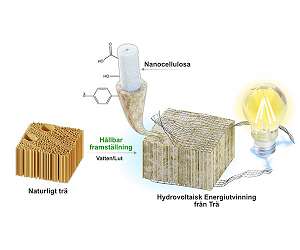
Researchers harvest electricity from wood soaking in water Stockholm, Sweden (SPX) Dec 14, 2022 Water and wood may one day be all that's needed to provide electrical power for a household. At a time when energy is a critical issue for many millions of people worldwide, scientists in Sweden have managed to generate electricity with the help of these two renewable resources. The method reported in the scientific journal Advanced Functional Materials by researchers at KTH Royal Institute of Technology focuses on what naturally happens after wood is placed in water, and the water evaporates. Tra ... read more
|
|||||||||||||
| The content herein, unless otherwise known to be public domain, are Copyright 1995-2026 - SpaceDaily. All websites are published in Australia and are solely subject to Australian law and governed by Fair Use principals for news reporting and research purposes. By using our websites you consent to cookie based advertising. If you do not agree with this then you must stop using the websites from May 25, 2018. Privacy Statement. Additional information can be found here at About Us. |


 del.icio.us
 Digg
Digg Reddit
 Google







