| . |  |
. |
| . | |
. |


Ames Laboratory Researchers Solve Fuel-Cell Membrane Structure Conundrum
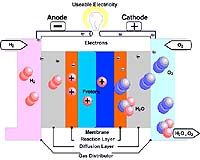
Ames IO (SPX) Dec 12, 2007 Fuel-cell cars are reaching commercial viability in today's increasingly eco-conscious society, but despite their promise, even scientists have struggled to explain just how the fuel-cell's central component - the proton exchange membrane - really works. However, a team of researchers at the U.S. Department of Energy's Ames Laboratory has offered a new model that provides the best explanation to date for the membrane's structure and how it functions. And armed with that information, scientists should be able to build similar fuel-cell membrane materials that are less expensive or have different properties, such as higher operating temperatures. A fuel cell works by pumping hydrogen gas through the proton exchange membrane. In the process, the hydrogen gives up electrons in the form of electricity, then combines with oxygen gas to form water as the by-product. It can also work in reverse - when current is applied, water is split into its component gases, hydrogen and oxygen. The model proposed by Ames Laboratory scientists Klaus Schmidt-Rohr and Qiang Chen, and detailed in the December issue of the journal Nature Materials, looked specifically at Nafion, a widely used perfluorinated polymer film that stands out for its high selective permeability to water and protons. Schmidt-Rohr, who is also a professor of chemistry at Iowa State University, suggests that Nafion has a closely packed network of nanoscale cylindrical water channels running in parallel through the material. "From nuclear magnetic resonance (NMR), we know that Nafion molecules have a rigid backbone structure with hair-like 'defects' along the chain," Schmidt-Rohr said, "but we didn't know just how these molecule were arranged. Some have proposed spheroidal water clusters, others a web-like network of water channels." "Our theory is that these hydrophobic (water-hating) backbone structures cluster together," he continued, "to form long rigid cylinders about 2.5 nanometers in diameter with the hydrophilic 'hairs' to the inside of the water-filled tubes." Though the cylinders in different parts of the sample may not align perfectly, they do connect to create water channels passing through the membrane material, which can be 10's of microns thick. It's this structure of relatively wide diameter channels, densely packed and running mostly parallel through the material that helps explain how water and protons can so easily diffuse through Nafion, "almost as easily as water passing through water" Schmidt-Rohr said. To unlock the structure mystery, Schmidt-Rohr turned to mathematical modeling of small-angle X-ray and neutron scattering, or SAXS/SANS. X-ray or neutron radiation is scattered by the sample and the resulting scattering pattern is analyzed to provide information about the size, shape and orientation of the components of the sample on the nanometer scale. Using an algorithm known as multidimensional Fourier transformation, Schmidt-Rohr was able to show that his model of long, densely packed channels closely matches the known scattering data of Nafion. Mathematical modeling of other proposed structures, in which the water clusters have other shapes or connectivities, did not match the measured scattering curves. "Our model also helps explain how conductivity continues even well below the freezing point of water," Schmidt-Rohr said. "While water would freeze in the larger channels, it would continue to diffuse in the smaller-diameter pores." Schmidt-Rohr added that additional analysis is needed to determine how the cylinders connect through the membrane. Community Email This Article Comment On This Article Related Links Ames Laboratory Iowa State University Powering The World in the 21st Century at Energy-Daily.com
 Darfur rebels say they attacked Chinese-run oilfield in Sudan
 Khartoum (AFP) Dec 11, 2007
Darfur rebel group the Justice and Equality Movement (JEM) said on Tuesday it had attacked and taken over a Chinese-run oilfield in central Sudan. |
|
|

| The content herein, unless otherwise known to be public domain, are Copyright 1995-2007 - SpaceDaily.AFP and UPI Wire Stories are copyright Agence France-Presse and United Press International. ESA Portal Reports are copyright European Space Agency. All NASA sourced material is public domain. Additional copyrights may apply in whole or part to other bona fide parties. Advertising does not imply endorsement,agreement or approval of any opinions, statements or information provided by SpaceDaily on any Web page published or hosted by SpaceDaily. Privacy Statement |