| . |  |
. |
| . | |
. |


 by Staff Writers Tampa (AFP) May 2, 2018
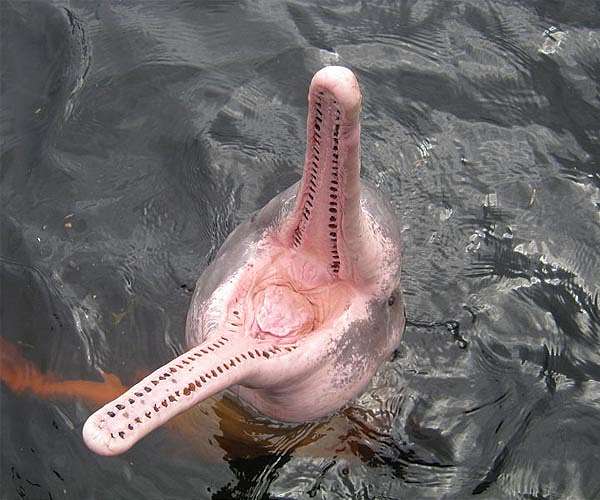
Two kinds of river dolphins are dying off fast in the Amazon region, and may face extinction unless they are more vigorously protected against fishing, researchers in Brazil said Wednesday. Once considered abundant in the Amazon basin, the boto (Inia geoffrensis) and the tucuxi (Sotalia fluviatilis) are now halving in population every 10 years, said the report in the journal PLOS ONE. Experts say the freshwater dolphins are increasingly being killed for use as bait, a practice that endangers their survival, particularly since the females bear a single calf on average every four to five years. "Until recent decades, the boto was sheltered from harm to some extent by legends and superstitions," but the relatively new hunt for them grew with the use of flesh and blubber as bait for catfish which have become widely available commercially, the study said. Researcher Vera da Silva from Instituto Nacional de Pesquisas da Amazonia and colleagues based their findings on 22 years of surveys in the Mamiraua Reserve in Brazil -- an area described as a core part of their range -- where dolphins have been tracked by boat monthly from 1994 to 2017. "At current rates, boto populations are halving every 10 years, and tucuxi populations are halving every nine years," said the report, which is the first to quantify current population trends in Amazon freshwater dolphins. "The results are profoundly concerning, and show rates of decline among the most severe of any measured in a cetacean population since the early years of modern whaling." The International Union for Conservation of Nature currently lists these freshwater dolphins as "data deficient," meaning not enough is known about their numbers in the wild to assess the degree of threat to the population. But the PLOS ONE study argued that if the IUCN Red List considered the latest findings, both species would be classified as critically endangered. River dolphins are already legally protected in the Amazon basin, but the laws need greater enforcement, researchers said. Another type of river dolphin found in South Asia (Platanista gangetica) is considered endangered by the IUCN. In China, the Yangtze River dolphin or baiji (Lipotes vexillifer), was declared functionally extinct in 2006 due to human activities like overfishing, dam building, pollution and boat traffic.
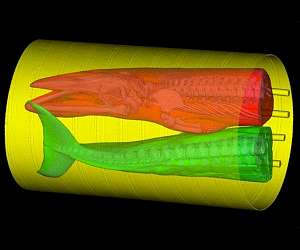
Scientists use rocket scanner to learn how whales hear Washington DC (SPX) Apr 24, 2018 Researchers have used a scanner designed for rockets to collect the first-ever computed tomography (CT) scan of an entire minke whale. By combining the CT scan results with custom-developed computer simulation tools, the researchers model how the whales hear sounds produced by other whales or by human-created (anthropogenic) sources such as ship propellers. CT, a common tool in in medical diagnostics, uses a special type of x-ray technology to take cross-sectional pictures of an organism or object ... read more
|
|||||||||||||
| The content herein, unless otherwise known to be public domain, are Copyright 1995-2026 - SpaceDaily. All websites are published in Australia and are solely subject to Australian law and governed by Fair Use principals for news reporting and research purposes. By using our websites you consent to cookie based advertising. If you do not agree with this then you must stop using the websites from May 25, 2018. Privacy Statement. Additional information can be found here at About Us. |

 del.icio.us
 Digg
Digg Reddit
 Google







