| . |  |
. |
| . | |
. |


 by Staff Writers Paris, France (SPX) May 04, 2016
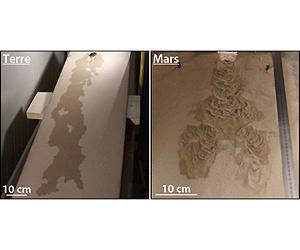
At present, liquid water on Mars only exists in small quantities as a boiling liquid, and only during the warmest time of day in summer. Its role has therefore been considered insignificant until now. However, an international team including scientists from the CNRS, Universite de Nantes and Universite Paris-Sud and headed by Marion Masse, from the Laboratoire de Planetologie et Geodynamique de Nantes (CNRS/Universite de Nantes)1 has now shown that even though water that emerges onto the surface of Mars immediately begins to boil, it creates an unstable, turbulent flow that can eject sediment and cause dry avalanches. The flow of small amounts of a boiling liquid therefore significantly alters the surface. The discovery of this exotic process, unknown on our planet, radically changes our interpretation of the Martian surface, making it difficult to undertake a direct comparison of flows on the Earth and on Mars. These findings are published on 2 May 2016 in the journal Nature Geoscience. It is well known that water boils at 100C. But this is only true at sea level, since boiling point depends on atmospheric pressure: the higher the altitude, the thinner the atmosphere, and the lower the boiling point. For instance, at the top of Mount Everest, water boils at 60C. But on Mars, where the atmosphere is much thinner than on Earth, it can boil at temperatures as low as 0C. During the Martian summer, when the subsurface water ice begins to melt and emerge at the surface, where the mean temperature reaches 20C, it immediately starts to boil. This is also the case for the flows of saline water discovered last year. So could an evaporating liquid alter the Martian landscape? To find out, a team of researchers from the Open University (UK) used a former diving decompression chamber to reproduce the low pressure of the Martian atmosphere. At the same time, another team from the GEOPS laboratory (CNRS/Universite Paris-Sud) carried out the same experiment, but this time in a cold chamber at Earth's atmospheric pressure. In both chambers, a block of pure water ice, followed by one of saline water ice, were melted at a temperature of 20C (as on Mars in summer) on a sand-covered slope. The experiments showed that, in the flows produced under terrestrial conditions, the water gradually seeped into the sand, leaving no trace on the surface after drying. However, what was observed in the Martian chamber was very different. The water produced by the melting ice started to boil as soon as it reached the surface, and the gas released caused the ejection of sand grains. These gradually formed small ridges at the front of the flow, which, as they grew larger, became unstable and actually produced avalanches of dry sand (video 1). The process was even more violent at lower pressures. Contrary to what is observed on Earth, the surface, once dry, therefore exhibited a series of ridges. This process is not as efficient in the case of saline water since it is more stable than pure water under Martian conditions. However, since saline water is more viscous, it can carry along sand grains and form small channels, a process that can sometimes become explosive under low pressure (video 3). These findings, analyzed along with other laboratories worldwide, including the Institut d'Astrophysique Spatiale (CNRS/Universite Paris Sud), provide new insight into the effect of the flow of water-whether saline or not-on the surface of Mars. Far from making its action insignificant, the water's instability considerably increases its impact on surface morphology. This broadens the potential range of processes that could explain the activity on the Martian surface, such as that observed in spring on the planet's slopes during the melt of winter frost made up of CO2 and water ice, as well as the dark flows (Recurring Slope Lineae) seen in summer. The possible presence of liquid water on the surface of Mars is a key question in the search for environments potentially favorable to life. Until now, detecting liquid water depended on identifying morphologies similar to those produced on Earth by the flow of liquid water, such as channels, gullies, or simply the seasonal appearance of dark traces caused by dampening of the surface. However the flows produced in the laboratory show that morphologies produced under either Martian or terrestrial conditions are very different. Direct comparison between landforms produced on Earth and on Mars does not therefore appear to be appropriate for detecting the appearance of a liquid on Mars, thus altering our interpretation of the Martian surface. Transport processes induced by metastable boiling water under Martian surface conditions, M. Masse, S. J. Conway, J. Gargani, M. R. Patel, K. Pasquon, A. McEwen, S. Carpy, V. Chevrier, M. R. Balme, L. Ojha, M. Vincendon, F. Poulet, F. Costard and G. Jouannic. Nature Geoscience, 2 May 2016. DOI : 10.1038/NGEO2706
Related Links CNRS Mars News and Information at MarsDaily.com Lunar Dreams and more
|
|||||||||||||
| The content herein, unless otherwise known to be public domain, are Copyright 1995-2026 - SpaceDaily. All websites are published in Australia and are solely subject to Australian law and governed by Fair Use principals for news reporting and research purposes. By using our websites you consent to cookie based advertising. If you do not agree with this then you must stop using the websites from May 25, 2018. Privacy Statement. Additional information can be found here at About Us. |


 del.icio.us
 Digg
Digg Reddit
 Google