| . |  |
. |
| . | |
. |


 by Eleni Ravanis | Student Collaborator - University of Hawaii Pasadena CA (JPL) Feb 01, 2022
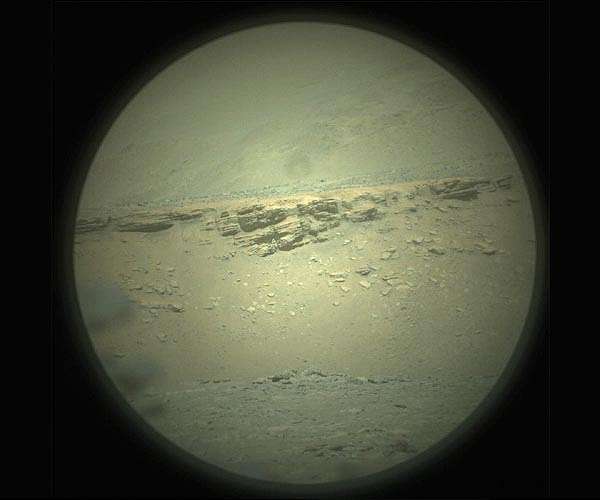
We'll soon be on the move again after shaking loose some pesky pebbles that became lodged in Perseverance's bit carousel. How has the science team been making the best use of our extended stay at the Issole parking space, and preparing for our next phase of science investigations? As outlined in our previous blog post, the team made good progress ejecting pebbles that became lodged in the interior of Perseverance's bit carousel, but two more stubborn ones remained on the outside. The rover recently completed a little "bump" of 3 meters and: success! The two remaining pebbles shook loose. Perseverance then repositioned itself again at the Issole outcrop to re-take what will be our second sample of a pair at this location (third time's the charm!) before driving back north again. In the meantime, the science team has been hard at work preparing for our next phase of science operations, which will take us towards the western delta. To prepare, the team has been taking long-distance observations of the delta and layers along Artuby ridge with both the Mastcam-Z and SuperCam instruments (e.g. a recent observation from the SuperCam Remote Micro-Imager is shown above). Our observations last week included Mastcam-Z stereo images of the western part of Artuby ridge that will allow us to create 3D models of the outcrop. We've also continued with atmospheric science, including data collection during a dust storm originating in Hellas that passed over the rover during sols 312-318 (~5th - 11th of January). Looking forward, after we finish sampling at this location, Perseverance will move back to Artuby ridge where we'll undertake proximity science at a location known as "Rimplas". After that, the team is still deciding whether to reattempt a sample at Roubion, where our first sample disintegrated, and/or to take a sample of the "Chal" member rocks, which are massive, blocky rocks closer to our landing site. These decisions, as all decisions on a mission as complex and ambitious as Mars 2020, will be a tradeoff between sols (the martian days we'll spend) and the expected science return. We'll then begin a multi-km drive aimed at reaching the delta as soon as possible. Along the way, science observations may include investigations of the craters we pass throughout our journey to the delta. This could be particularly useful for understanding the sequence of events at Jezero crater, which may be revealed in exposures along the crater walls. The team is starting to plan these observations now, because with Perseverance's autonomous driving capabilities, we'll be at the delta before we know it. The team is looking forward to being on the road (or on the rove) again!
Out of Pebble Purgatory Pasadena CA (JPL) Jan 28, 2022 The final two pebbles hitching a ride aboard our rover's bit carousel are gone but not forgotten. I'll give you the latest on why they are gone and then tell you why we are not forgetting them - or the two other pebbles that made our first month of 2022 a busy one. We had more than a suspicion the rocks had departed the Perseverance rover on Sunday when imagery of the bit carousel came down after a short 16-foot (5 meter) drive to a nearby rocky outcrop. That drive, which took place on the previou ... read more
|
|||||||||||||
| The content herein, unless otherwise known to be public domain, are Copyright 1995-2026 - SpaceDaily. All websites are published in Australia and are solely subject to Australian law and governed by Fair Use principals for news reporting and research purposes. By using our websites you consent to cookie based advertising. If you do not agree with this then you must stop using the websites from May 25, 2018. Privacy Statement. Additional information can be found here at About Us. |

 del.icio.us
 Digg
Digg Reddit
 Google






