| . |  |
. |
| . | |
. |


 by Staff Writers Paris (AFP) Oct 22, 2019
An all-out shift to organic farming in England and Wales could lead to a net increase in Britain's greenhouse gas emissions as a drop in yields would lead to higher food imports, scientists estimated Tuesday. While going organic creates lower emissions per foodstuff -- up to 20 percent lower for crops and 4 percent for livestock -- it also makes farming less efficient, as fertiliser use encourages food to grow quicker. A team of researchers from Cranfield University found that direct emissions from farming in England and Wales would go down if the agriculture sector ditched nitrogen-based fertilisers and went fully organic. But yields would drop by up to 40 percent, meaning more land would need covering to pasture and cropland to make up for the losses -- thereby contributing to a net increase in planet warming greenhouse gases. "Although there are undoubted local environmental benefits to organic farming practices, including soil carbon storage, reduced exposure to pesticides and improved biodiversity, we need to set these against the requirement for greater production elsewhere," said Guy Kirk, professor of soil systems at Cranfield. The farming sector contributes upwards of a quarter of all manmade emissions globally, and a string of high profile reports in recent years have warned that unsustainable mass-scale agriculture imperils the Paris climate goals. While nitrogen-based fertilisers release powerful greenhouse gases, livestock release methane on a mass scale, leading some to call for diets lower in meat in developed nations. Tuesday's study, published in the journal Nature Communications, found that purely organic farming would increase beef cattle and sheep numbers due to increased pastureland, while pigs, poultry and eggs would decrease, largely because of a lack of concentrated feed. The authors said that a net reduction in greenhouse gas emissions if Britain went fully organic would only be achievable in conjunction with "widespread changes to national diets".
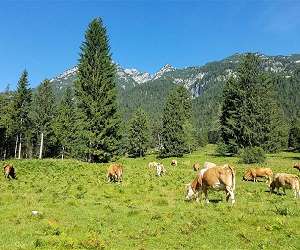
Land-based measures in Europe require food system transformation Karlsruhe, Germany (SPX) Oct 16, 2019 Forest protects the climate. Reforestation can decisively contribute to mitigating global warming according to the Paris Agreement. Based on simulations, researchers of Karlsruhe Institute of Technology (KIT) have studied the conditions that should be fulfilled in Europe for this. According to the study published in Environmental Research Letters, sufficient increase in forest areas requires a transformation of the food system and in particular, the reduction of meat consumption. According to the ... read more
|
|||||||||||||
| The content herein, unless otherwise known to be public domain, are Copyright 1995-2026 - SpaceDaily. All websites are published in Australia and are solely subject to Australian law and governed by Fair Use principals for news reporting and research purposes. By using our websites you consent to cookie based advertising. If you do not agree with this then you must stop using the websites from May 25, 2018. Privacy Statement. Additional information can be found here at About Us. |

 del.icio.us
 Digg
Digg Reddit
 Google







