| . |  |
. |
| . | |
. |


 by Staff Writers Vancouver, Canada (SPX) Aug 07, 2017
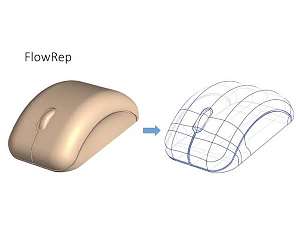
A University of British Columbia computer scientist has created a new software that can create a design sketch of an everyday object, addressing the challenge of accurately describing shapes. The program, called FlowRep, was designed by computer science professor Alla Sheffer, in cooperation with Adobe Research and Washington University in St. Louis. "If you try to explain what your computer mouse looks like to someone who has never seen a mouse before, you're going to struggle to verbally describe its shape," said Sheffer, who unveiled the new program at SIGGRAPH 2017, the world's largest computer graphics and interactive techniques conference. "Humans are good at verbally describing colour or dimensions, but cannot easily articulate geometric properties. The easiest way to describe shapes is to sketch them." To create the program, Sheffer used insights from a field of psychology known as Gestalt psychology that explains how humans interpret visual content and understand depth from two-dimensional drawings. The algorithms she developed based on these insights help turn diverse shapes like airplanes, cars, coffee makers and mugs into sketches. "All you need is a dozen strokes or less and people will be able to envision the geometry of an object," she said. "This program answers the question about which surface curves we need to trace so that human observers can imagine a shape." This research builds on earlier algorithms that Sheffer and her colleagues developed that can turn sketches and drawings into 3D shapes. Together, these methods can be used to recreate objects around us and has implications for fields like 3D printing and fabrication. Sheffer's program has worked well in user studies. The sketches and 3D curves produced by the algorithm were deemed comparable to those produced by professional designers. Sheffer is now looking to explore additional applications of the system. Since the current algorithm is best suited for man-made rather than natural shapes, Sheffer is also looking into improvements that will allow the system to produce top quality sketches of natural shapes.
 Using water displacement as the 3-D shape sensor for complex objects
Chicago IL (SPX) Jul 24, 2017 A global team of computer scientists and engineers have developed an innovative technique that more completely reconstructs challenging 3D objects. An ancient scientific breakthrough serves as the foundation for the team's modern, innovative solution to remaining challenges in current 3D shape reconstruction. This new approach to 3D shape acquisition is based on the well-known fluid displa ... read more Related Links University of British Columbia Space Technology News - Applications and Research

|
|||||||||||||
| The content herein, unless otherwise known to be public domain, are Copyright 1995-2026 - SpaceDaily. All websites are published in Australia and are solely subject to Australian law and governed by Fair Use principals for news reporting and research purposes. By using our websites you consent to cookie based advertising. If you do not agree with this then you must stop using the websites from May 25, 2018. Privacy Statement. Additional information can be found here at About Us. |

 del.icio.us
 Digg
Digg Reddit
 Google





