| . |  |
. |
| . | |
. |


 by Staff Writers Bochum, Germany (SPX) Jul 03, 2020
Better still: living algae can be used as biocatalysts for certain substances, and they bring the co-substrate along, producing it in an environmentally friendly manner through photosynthesis. The team published its report in Algal Research on 17. June 2020. Many chemical substances in cosmetics, food or medicines can assume slightly different three-dimensional structures, with only one of them generating the desired fragrance or medical effect. The chemical production of the right substances is often not environmentally friendly, as it requires high temperatures or special solvents. In nature, however, certain proteins do exist that produce the required product at mild temperatures and in water. In the process, they often generate exactly the 3D structure of the substance that is needed by the industry. These so-called old yellow enzymes, OYEs for short, owe their name to their naturally yellow colour. They occur in bacteria, fungi and plants, are in part well studied and offer considerable potential for a bio-based economy. However, they have one disadvantage: in order to carry out their reaction, they need the co-substrate NADPH (nicotinamide adenine dinucleotide phosphate). In living cells, this small molecule is generated through metabolic processes, whereas its chemical production is very expensive; as a result, the commercial use of OYEs is thwarted.
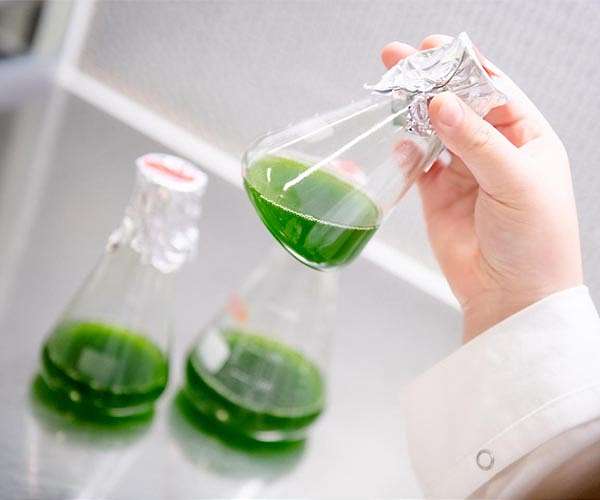
OYEs from unicellular green algae: two birds with one stone "Algae possess very complex metabolic pathways and are therefore ideal sources for novel biocatalysts." The researchers analysed algal OYEs in the test tube and showed that they are able to convert many commercially viable substances. "The exciting thing is that living algae can also carry out the reactions needed in the industry," points out PhD student Stefanie Bohmer, lead author of the study. "Since algae produce NADPH using photosynthesis, i.e. with sunlight, the co-substrate of the OYEs is supplied in an environmentally friendly and cost-effective way."
Promising collaboration Four researches from the Research Training Group "Micon - Microbial substrate conversion", which is funded by the German Research Foundation, contributed their expertise to the study. The project was the brainchild of Solarbioproducts Ruhr, a spin-off established by Wirtschaftsforderungsgesellschaft Herne and Thomas Happe with the aim of developing concepts for environmentally friendly algae biotechnologies. "We have taken a big step towards a green industry," concludes Happe. "This would not have been possible without collaboration."
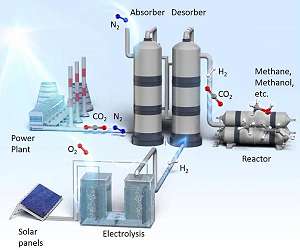
The exhaust gas from a power plant can be recovered and used as a raw reaction material Nagoya, Japan (SPX) Jun 21, 2020 A research group at Nagoya University has developed a new technology that can drastically conserve the energy used to capture carbon dioxide (CO2), one of the greenhouse gases, from facilities such as thermal power plants. Conventionally, a significant amount of energy (3 to 4 GJ/ton-CO2) or high temperatures exceeding 100 deg.C has been required to capture CO2 from gases exhausted from a concentrated source, and there are expectations of the development of CO2 capture technology that consumes les ... read more
|
|||||||||||||
| The content herein, unless otherwise known to be public domain, are Copyright 1995-2026 - SpaceDaily. All websites are published in Australia and are solely subject to Australian law and governed by Fair Use principals for news reporting and research purposes. By using our websites you consent to cookie based advertising. If you do not agree with this then you must stop using the websites from May 25, 2018. Privacy Statement. Additional information can be found here at About Us. |

 del.icio.us
 Digg
Digg Reddit
 Google







