| . |  |
. |
| . | |
. |


Air Forces Use Joint STARS To Demo Secure, Airborne Internet
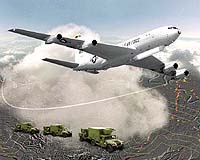
Melbourne FL (SPX) Dec 21, 2004 The U.S. Air Force and Northrop Grumman successfully demonstrated an airborne capability to collaborate real time via Internet 'chat rooms', e-mail, and the Web, all within a secure, classified environment. Known as ICAN, or Interim Capability for Airborne Networking, the new approach allows personnel on board the E-8C Joint Surveillance Target Attack Radar System (Joint STARS) aircraft to "talk" to units and command centers on the ground. The ICAN system achieves this communication by routing data through existing Joint STARS radios into the Department of Defense's Secret Internet Protocol Router Network. Northrop Grumman and the Air Force completed the ICAN proof of concept phase on an E-8C Joint STARS aircraft during recent exercises at Nellis Air Force Base, Nev. ICAN is a follow-on to the company's successful Dial-up Rate IP over Existing Radios (DRIER) demonstration on Joint STARS a year ago. "This capability gives us access to conversations taking place in decision-making chat rooms in the air operations center," said Nick Gritti, Northrop Grumman's Joint STARS ICAN program manager. "This access allows Joint STARS crews to respond directly to issues being raised, rather than waiting for a radio call after the fact. A system like ICAN would allow aircrews in intelligence, surveillance and reconnaissance aircraft to share network-centric operations with their terrestrial counterparts, resulting in dramatically shorter strike decision times." According to Gritti, the information that can be shared over an ICAN-enabled system is valuable for safe and effective command and control decisions and for synchronizing operations among the services. The recent ICAN demonstration was conducted under a contract from the Air Force Research Lab and the Joint STARS System Program Office. It involved engineers from Northrop Grumman's Integrated Systems sector in Melbourne and the company's Information Technology (IT) sector facility in New Hartford, N.Y. The demo used IT-developed hardware and software to interface with existing HF (high frequency), UHF (ultra high frequency, and VHF (very high frequency) and satellite communications radios aboard the aircraft to relay information in real time to command centers on the ground. "The system worked better that we thought possible using existing aircraft radios," said Dave Nagy, Northrop Grumman's Joint STARS program vice president. "That's important because ICAN is an essential part of our work to evolve Joint STARS into a low-risk, high-potential airborne network node than can be linked into the Secret Internet Protocol Router Network. These tests also proved the value of using Joint STARS as a risk-reduction tool to demonstrate emerging technologies as DoD moves towards network-centric warfare with our E-10A program as a centerpiece." Related Links Northrop Grumman SpaceDaily Search SpaceDaily Subscribe To SpaceDaily Express
 Northrop Grumman Completes Major Risk-Reduction Step For Advanced EHF Model
 Redondo Beach CA (SPX) Dec 21, 2004
Northrop Grumman Corporation has completed integrating engineering model payload elements into a single-string prototype for the new Advanced Extremely High Frequency (EHF) military communications satellite, which allowed the company to successfully demonstrate performance capabilities. |
|
|

| The content herein, unless otherwise known to be public domain, are Copyright 1995-2006 - SpaceDaily.AFP and UPI Wire Stories are copyright Agence France-Presse and United Press International. ESA PortalReports are copyright European Space Agency. All NASA sourced material is public domain. Additionalcopyrights may apply in whole or part to other bona fide parties. Advertising does not imply endorsement,agreement or approval of any opinions, statements or information provided by SpaceDaily on any Web page published or hosted by SpaceDaily. Privacy Statement |